Happy Birthday to Me!

Posted on

On February 21st, I celebrated my birthday. I am one of those people who love birthdays. So many people die early and we lost quite a few people last year. It’s good to be alive. Every new birthday is a reason to be happy that we are still alive. Every day we get to spend with our loved ones and to be productive is a reason to say, “Hurray!”

This year, I gave myself the gift of a TEDx Talk. It happened to be on February 20th, just one day before my birthday. Just kidding. It worked out that way, I did not actually set out to say, “I know what I want for my birthday in 2016! To give a TEDx talk!”

Purple Fitbit

My favorite color: purple

My husband and children gave me a Fitbit and workout clothes, because they know I am serious about my fitness. It was fun for my daughter to pick the colors, my husband tells me. And my son read the instructions for my Fitbit and very seriously advised me on how to use it.

I am a blessed woman and thank God for my family and the good times we have together. They took me out to eat for lunch. There is a Japanese restaurant in Pigeon Forge where they prepare the food right in front of you. We thought it might be cool for the kids to see this. We had been there before, but apparently they do not remember it.

In the evening, daddy read to the kids while I watched the one show I watch on TV: Downton Abbey. Can you believe Lady Mary? How mean she can be! Anyhow, Julian Fellowes (the writer) better wrap things up nicely for Lady Edith. He has two more episodes to do so.

Sometime in the afternoon I spoke with my mom and thanked her for giving birth to me. It’s good to have a mom still alive, isn’t it? This is my first birthday without a father.

This has been a great birthday and I look forward to this next year!

Tuesday Tome Week 7 – 10 Ways to Destroy the Imagination of Your Child

Posted on

This book is dynamite. I bought it in 2013 and I just now got around to reading it. You see, I read the chapter headings and I knew I agreed wholeheartedly with every single point. I had more urgent things to do and read, so I kept this book on the shelf.

But its time had come. I am glad I read it. Even if you agree with broad principles, there are details that make all the difference. Anthony Esolen, the author, grew up Catholic and went to Catholic schools. He experienced some of the deterioration of the American educational system even in the private, Catholic system. And he writes tongue-in-cheek through the whole book, which keeps things interesting and funny.

Tuesday Tome

He talks about how the government wants dummies it can control. Hence, public education has been dumbed down so that it produces citizens who feel powerless, lack initiative, and feel dependent on a technocratic state. If a child has imagination, he just might break out of the mold and forge an independent career outside “the system” and Uncle Sam, of course, does not want that.

Here are the 10 ways to destroy the imagination of your child:

  1. Keep him indoors. If a child sees the sky, especially at night, he might actually start dreaming and be inspired about the vastness of the universe. Who knows where such liberating, inspiring thoughts might take him?
  2. Schedule every minute of your child’s life. If you leave children get bored for a few minutes, they will actually come up with new games and ideas to entertain themselves, which develops the imagination.
  3. Keep children away from machines. Mechanical gadgets fascinate and inspire and empower children to develop new ideas and technologies – a threat to a technocratic state which hates “unauthorized personnel.”
  4. Replace the fairy tale with political cliches. Here’s a quote from page 97: “Fairy tales and folk tales are for children and childlike people, not because they are little and inconsequential, but because they are as enormous as life itself… It is not a failure of imagination to see the sky as blue. It is a failure rather to be weary of its being blue – and not to notice how blue it is. An appreciation for the subtler colors of the sky will come later. In the folk tale, good is good and evil is evil, and the former will triumph and the latter will fail. This is not the result of the imaginative quest. It is rather its principle and foundation. It is what will enable the child later on to understand Macbeth, or Don Quixote, or David Copperfield.” Page 96: “It has been a great victory for the crushers of imagination to label such figures ‘stereotypes,’ and add a sneer to it, as if people who used them in their stories were not very imaginative…” Page 98: “In any case, when you starve your child of the folk tale, you not only cramp his imagination for the time being. You help to render vast realms of human art (not to mention human life) incomprehensible.” Liberals will tell you that “teaching is a political art” and they will not understand why we have to read Virgil.
  5. Cast aspersions upon the heroic and the patriotic. P. 140: “The imagination seeks out the ideal, and beholds its beauty. In doing so it penetrates farther to the truth than does the sloth of cynicism.” So history is taught today by magnifying the faults of its heroes.
  6. Cut all heroes down to size. P. 146: “Boys in particular are natural hero-worshipers.” So teach them to sneer at people who accomplish difficult tasks, like crossing half-starved men across the icy Delaware on a night-attack against professional soldiers at Trenton (George Washington, in case you did not know the story). Teach them to snicker at anybody possessing moral excellence. Help them laugh at what they do not understand. Teach them to hate and suspect excellence. Build up their carapace of self-absorption.
  7. Reduce love to sex and narcissism. Enough said.
  8. Level distinctions between men and women. Popular culture, wrongly called “culture,” is actually mass entertainment. It talks “glibly about traditional manhood and traditional womanhood with a knowing wink – meaning brutality and idiocy. That such men and women, possessed of virtues we ignore, tamed a continent, is not to be considered… Have children understand that manliness and womanliness are contemptible. The true man is a cartoon figure, a crazy mixture of steroid-exploded muscle mass, grunts, and a bad shave. Otherwise men are fat, sloppy, and stupid. They paint their bellies for football games and drink beer. They are incompetents in the workplace. Their conversation revolves around fast food and fast women. For their part, the women are skinny to the point of emaciation. They wear clothes that wold make the whores of old blush. They are fussy, snippy, and feline. They enjoy humiliating men, who always come back for more anyway. They have studied martial arts, and can be choreographed into delivering a backhand slap from a thin-wristed arm that will defy all the laws of physics and send a 250-pound man reeling. They have foul mouths, but they don’t come by the foulness honestly; a sort of sneaky, sniggering arch foulness…”” (p. 196)
  9. Distract the child with the shallow, unreal, and the noise. The noise of video games, TV screens, and modern music allows no time for reflection and developing a listening ear for what really matters. Jesus said, “Let him who has ears to hear, hear.” (Mark 4:23) Elijah listened to the still small voice, which was a faint whispering sound, after the Lord was NOT in the whirlwind, the fire, or the earthquake. Albert Einstein, daydreaming on the hillsides of Tuscany, bathing in the Mediterranean sunlight, wondered about light and what it would be like to ride a ray of sunlight. He listened to the light and came up with the theory of relativity. Silence fosters imagination.
  10. Deny the transcendent. Esolen makes a case against children’s Bibles, with their cartoonish images of God, Jesus, and the great heroes of old. He wants children to read and not understand everything in the Bible at first. It is OK to be intimidated, to not know what “issue” means, or “boils.” These things can be explained in due time. But the idea is to make the child connect with God’s mind through a reading of the original text, not some watered down version for children.

I hope I have whetted your appetite for this entire book. You will want to get your own copy so you can underline passages and refer to them every time you are tempted to sit your child in front of a screen.


Subtraction with Borrowing

Posted on

It took me three days and several methods to teach my son subtraction with borrowing. Math has never been a tough subject for him. He understands place value and trading one ten for ten ones. He just did not understand why we did all the maneuvering around.

So I backtracked and showed him some cute videos on YouTube: this, this, and this. He thought the Khan Academy’s video on the subject was too dry and boring and still did not get it. I usually scoff at the idea of Sesame Street style teaching, but desperate situations require desperate measures. I knew I would stoop to this level just so my kid would get it. And then we can go back to our regularly scheduled programming, to use terminology from the oft-despised world of television.

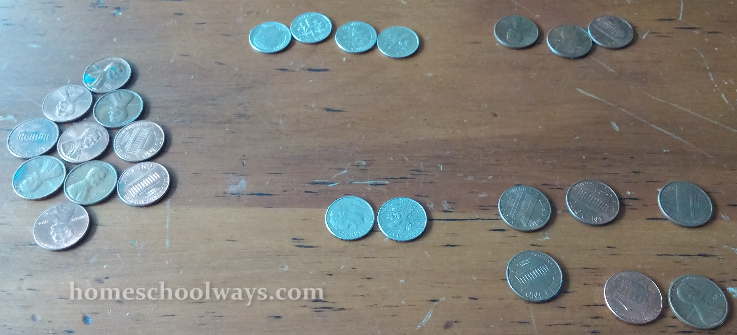
43-26 shown with dimes and pennies; 10 pennies waiting on the side to be traded for a dime.

43-26 shown with dimes and pennies; 10 pennies waiting on the side to be traded for a dime.

I got online and looked at some videos on how to teach subtraction with borrowing myself. Some of them bored me to tears, but I appreciated the efforts of all these math teachers out there who took the time to offer this online for free. Thank you.

In the process, I learned that borrowing is considered antiquated now as a term. We now say “regrouping.” Both terms are incomplete, in my book, because the operation involves borrowing first and then regrouping.

I also learned that Common Core advocates call this “granny math.” The way to do subtraction with regrouping under Common Core Standards is to count up to the nearest number that ends in a 0 or a 5, like giving change. Excuse me?

If that’s not a way to create a generation of dummies which can be easily controlled and manipulated by a technocratic state, I don’t know what is. What’s wrong with the old way? It teaches children to think. Ironically, Common Core advocates state the opposite. They claim their way of doing math is the way to get a child to think. I disagree. Continue reading »


TEDx UTK

Posted on

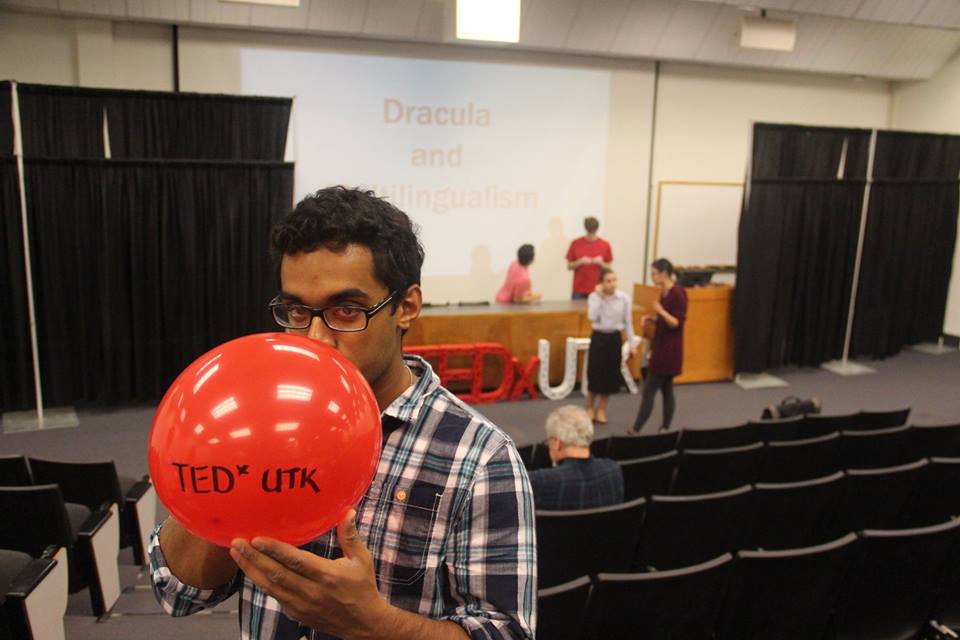
On February 20, 2016 I will give a TEDx talk at the University of Tennessee in Knoxville. The venue chosen for this year is the McClung Museum of Natural History. There will be two sessions, morning and afternoon. I speak in the morning.

The event is sold out as of yesterday. They will stream it live and they will also upload the talks to YouTube afterwards. I will get back with you and give you the links when it is all said and done.

TEDxUTK

TEDx UTK is an independently organized event in the style of TED talks you may be familiar with from YouTube and their own site.

My talk is “Dracula and Multilingualism.” I will show how multilingualism can open doors and take you places, the connection between Dracula and multilingualism, as well as the connection between me and Dracula.  Continue reading »


Tuesday Tome Week 6 – Jane Eyre

Posted on

Charlotte Bronte’s Jane Eyre is a masterpiece. No wonder then that of all the things the Bronte sisters wrote, Susan Wise Bauer included only Jane Eyre into her list of 32 novels produced by the Western world since the genre was created, around the 1600s. Jane is way ahead of her time. She makes herself the equal of a man (a wealthy gentleman, too) – great feat in 1847! – through conversation and wit and attitude.

Jane Eyre

But Jane Eyre is more than just an early feminist. She is a Christian who is grappling with injustice, hypocrisy, delusion, and missionarism in the people around her. Some have said this book is anti-Christian because of characters like Mr. Brocklehurst and St John Rivers. These men seem more like caricatures, but have you not met hypocritical characters in your local congregation? Have you not met exalted young missionaries who are deluded into thinking they are doing God and the world a favor through their daily sacrifices? I know I have met my fair share of such people. So this book spoke to me on a very personal level.  Continue reading »


2016 Ski Season

Posted on

Last year, my son and I started taking ski lessons. These lessons are offered for homeschoolers but we have also met public school children. The lessons happens on Sunday mornings, so it really is an accessible time for everybody. One must be at least seven to start.

Mom and son on the ski slopes

My son and I at Ober Gatlinburg in February 2016

We were both beginners last year. I had been on skis twice before, but without much success. So I really was a beginner as well. This year, we are taking intermediate classes. Riding the chair lift was really scary for me in the beginning, especially when it gets really high in places.  Continue reading »


TeenPact One Day

Posted on

I wrote here back in November about signing up for TeenPact One Day. Well, the day came when we had to pack for Nashville and head that way. We decided to go there the night before, because Nashville is four hours away from our home. The program started at 10am and it would have been very difficult to leave the house around 5am to give ourselves time for stopping and breakfast etc.

Our daughter at the Adventure Science Center in Nashville

Our daughter at the Adventure Science Center in Nashville

Teen Pact One Day is a six-hour program for children ages 8-12 which happens at the Capitol building. They have them all over the US and you should locate your state on the map and see about the dates for your state.  Continue reading »


Tuesday Tome Week 5 – Oliver Twist

Posted on

After Pride and Prejudice, it was very difficult to motivate myself to read Oliver Twist – just too much sadness and unfairness and mind-blowing coincidences. I like believable stories and while I believe Victorian London really was as bad as described in this book, I just have a hard time with the coincidences.

But the idea of reading Charles Dickens, one of the greatest novelists in the English language, motivated me in the end. Anything in the name of literature!

Oliver Twist

On the other hand, I came up with this idea that, of the entire novel list from The Well-Educated Mind, I should allow myself to skip two if I felt like it. I know one of them will be Moby Dick. I refuse to read this book simply because Susan Wise Bauer herself says she has not finished it, even though she started it 17 times. And yet, she wrote a long paper about it in graduate school and passed her exam with flying colors. Which says a lot about graduate school in the US, but also about the dedication needed to finish this grueling novel.  Continue reading »


Very Young People’s Concert

Posted on

For the first time, we attended a Very Young People’s Concert by the Knoxville Symphony Orchestra. It was wonderful. We plan to go again next year.

The Knoxville Symphony Orchestra tuning up before the concert

The Knoxville Symphony Orchestra tuning up before the concert

We had tickets for it last year, but inclement weather canceled the concert altogether and we got our money back. So we were happy the weather cooperated this year.  Continue reading »


Starting Cursive

Posted on

If you have been reading this blog for a bit, you may know that I do not believe in teaching manuscript first and then cursive. In fact, I don’t believe in teaching manuscript at all. My children will experience what I did when I went through school: cursive first and only.

In preschool, they learned to print: MAMA LOVES ME, for instance. In the second semester of kindergarten, they started learning cursive. By first grade, they would be ready for copy work and a writing program. We spend most of first grade perfecting handwriting, all in cursive.

Girl holding tablet with cursive handwriting

Her first lesson in cursive handwriting

Romanian children and children elsewhere have done it for centuries. Manuscript first is a relatively new phenomenon and the result of extremely liberal principles introduced in education, one of them being dumbing down the curriculum. I am surprised by the number of conservative people who have not looked into this issue more carefully.

Since small children may not have the tactile skills for holding a pen properly, I have always made it a goal to wait until mine were at least six years of age before starting cursive. My daughter is one month away from being six, but she recently asked to start cursive.  Continue reading »