Sevierville Library Used Book Sale

Posted on

Recently, I came across this quote by Barbara Tuchman: “Books are the carriers of civilization. Without books, history is silent, literature dumb, science crippled, thought and speculation at a standstill. They are engines of change, windows on the world, lighthouses erected in the sea of time.” Of course, we love books in our homeschool.

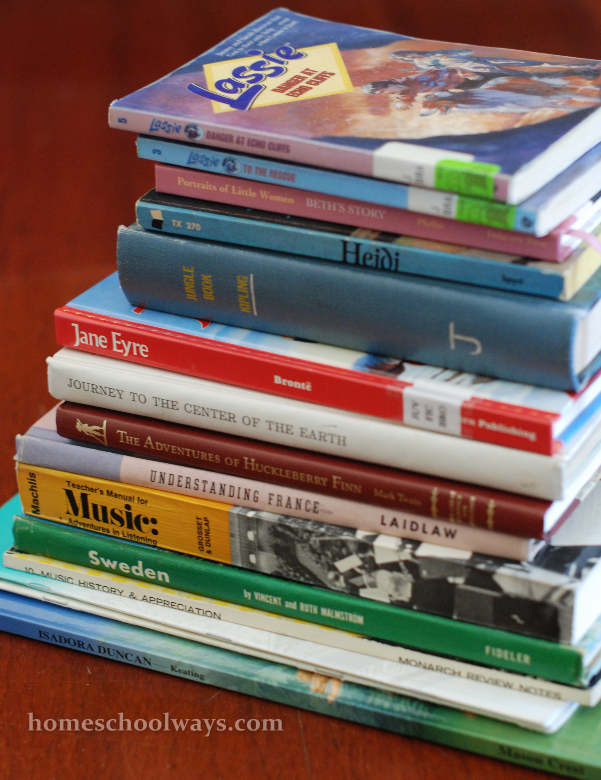
Stack of books bought at the King Family Library Used Book Sale

I bought all these books for less than $10 at the King Family Library Used Book Sale

Yesterday, I took the kids to the Sevierville Library to return some books. They had a used book sale going on, so we looked around. How can you go wrong when these books go for $0.50 or $0.25? I knew they did this twice a year or so, but had never taken the time to check it out. Wow! I have been missing out all these years.

We came back with an armful of books, many of them classics like “Heidi” and “Lassie” and “The Adventures of Huckleberry Finn.” I spent less than $10.

I like the fact that they are used. They remind me of the books we used to check out as children in Romania – brown pages, corners turned, the name of a previous owner on the cover, stamps from various different libraries it used to belong to. These pages, worn out by many eager fingers, have offered adventures beyond the reach of many.

Many of the books I found are in like new condition, too. I found geography books on France and Sweden, a biography of Isadora Duncan written for children, classics by Mark Twain and Charlotte Bronte and anything in between.

The sale goes on for a few more days. The next sale starts on September 15. You want to be there, if you live in the area and like books. You never know what treasures you may find for your homeschool.


Media Talk 101 Review

Posted on

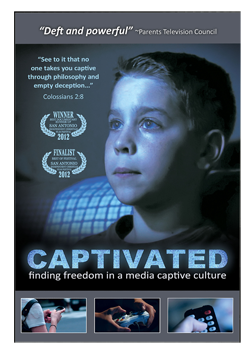
As a member of The Old Schoolhouse Review Crew, I recently had the opportunity to watch Captivated, a documentary about the plugged-in world we are living in, produced by Media Talk 101, a small company dedicated to informing the public about the dangers of a lifestyle that takes a bit too much advantage of the digital age.

From the very beginning, I was impressed with how professionally the documentary was put together. The script is well written, too. The producers brought in a series of leaders in modern Christianity, as well as medical doctors and family therapists, to analyze the proliferation of screens in our lives and its effect on relationships.

This DVD costs $16.95.  The shipping is free. If you wanted to order a second one for sharing, it’s only $5. If you have teens, they should definitely watch it with you. I have small children and I did not show it to them. If you have middle school age children, it’s your decision. The movie has been approved for all ages.

I liked the images of the film’s creator in Times Square – the epitome of our fast lifestyle – in the beginning and at the end of the documentary and how they tie the message together.

Another telling image is that of a man on his cell phone in the middle of a corn field. “Where can I go to flee from your presence?” exclaimed David toward God. That might as well be our cry towards screens, which surround us no matter where we go.

The documentary begins with a bit of history and it zooms in on the advent of the telegraph. It was a significant moment in human history because, for the first time, the message could travel faster than the messenger. For the first time, people could be connected remotely without needing to walk, ride a horse, a car, or a train.

I met my husband online, so I was delighted to hear that people met vicariously as early as 1890. “Wired Love,” a love novel from that era, was inspired by a true story. Two people who met via Morse code finally met in person. Since they could not really communicate with each other and it all seemed awkward, they walked in two separate rooms and he proposed via the telegraph. How romantic, right?

The documentary is divided in five parts: Media Consumption, Content, Captivity, Battleground, and Freedom.

Want some startling stats? Today, we have more TVs than children in our homes. In some homes, there are more TVs than people in the home. American children spend over 53 hours per week in front of a screen.

Captivated Movie Review

We wonder why our youth seems so passive and unmotivated. All that screen time tricks the brain into thinking you have done something, when, in fact, you have just wasted your time and accomplished nothing.

The youth seem to think they can multi-task. That they can study while watching TV and monitoring their cell phones which, besides text messages, alerts them instantly of any social media updates. Experts agree that nobody can multi-task.

This life spent plugged into some sort of virtual reality is slowly but surely changing the definition of what it means to be a human.

The documentary recommends a series of books for further study: “Distracted” by Maggie Jackson, “The Dumbest Generation” by Mark Bauerlein, “Amusing Ourselves to Death” by Neil Postman – among others. I thought the word “amuse” spoke volumes: amuse = a + muse, where a = not and muse = think. So next time you go to an amusement park, think again. I have never liked amusement parks and now I know why.

The documentary introduces the idea of a media fast. You know how Jesus mentioned there are some type of demons that can only leave us alone with praying and fasting? I believe that is true for the mind, as well. You try to go on a day media fast and you will see how hard it is not to reach for the cell phone or the iPad. Try a week or a month. Are you already coming up with excuses describing how legitimate your need is to log into your Facebook or email account? There’s your answer.

“Captivated” lists the physical downsides of technology: obesity, sleep interruption, hearing problems, eye strain, carpal-tunnel syndrome, just to name a few. What is alarming though is the reality that media addiction is worse than a drug addiction.

The documentary also shows a case study from a school where the parents complained their children had ADD. The principal said, “It is your decision as parents to put your children on medication. But, before you do, please take a month and do the following:

  • give your children three nutritious meals a day
  • put them in bed by 9pm
  • limit their screen time to 30 minutes per week
  • have them play outside one hour per day
  • have them play outside three hours on weekends

Then come back and tell me what you have found out.”

The parents agreed and, at the end of the experiment, came back to the principal to report that their children did not have ADD symptoms anymore.

Captivated Movie Review

The documentary also shows Shepherd’s Hill Academy, a residential facility where teens go to overcome their media addiction, which has made them out of control. Their testimonies were touching. I used to work in a similar place and it brought back memories.

Parents need help discerning what kind of content to put in front of their children, if they decide on allowing screen time at all. We are so bent these days on not censoring anything, that we have forgotten the Bible teaches we are to take every thought captive to the obedience of Jesus Christ.

Let me paraphrase another great quote from the documentary. They said television was a vast wasteland in 1961. Well, if that is true, television now is a toxic dump. These are words from television executives and people involved in the Parents Television Council.

Ever wondered who is behind the uber-useful website PluggedIn.com (run by Focus on the Family), where you can read reviews on pop culture products from a biblical perspective? I did. Well, his name is Bob Waliszewski and he appears on “Captivated.” He encourages parents to remember that it is OK to deny ourselves and our children. We are called to take up our crosses and follow Him.

The documentary manages to present our challenge as Christians and parents today without being too preachy. I thoroughly agree with the message of this documentary. We limit our children’s screen time to 30 minutes per day. But here are some things they could do better:

  • the documentary should be heavily edited for length; do we really need to spend 107 minutes in front of a screen which tells us about the evils of sitting in front of screens? That’s an irony which will not escape those who oppose the message. My husband gave up on it after about 45 minutes. We did not show it to our young children.
  • the families portrayed in the documentary have six or more children; that’s unusual to those of us who are not of the “quiverful” persuasion; it can be a turn-off to the mainstream American family.
  • the ladies on the documentary wear very long skirts; I understand conservative circles will watch this DVD and may have paid for the making of this DVD, but mainstream Americans do not dress that way. They might feel as if they have stepped into some kind of back country compound bordering a cult sub-culture.
  • if you propose we turn off the screens, please give us more ideas about what to do with ourselves, besides reading the Bible, foraging, playing an instrument and learning new skills. Not everybody is excited about foraging and the documentary spends a good ten minutes presenting this family’s new found passion. Not everybody is musically inclined. Not everybody can read the Bible for an hour at a time. As for new skills, when one has small children, online courses are the golden ticket but oops, that’s more screen time.

For sure, as parents, we need discernment in every aspect of our parenting ministry to our children. Media is a huge one and “Captivated” will help you focus and find some solutions for your particular situation.

For all their bashing of social media, the producers have accounts there:

Facebook  httpss://www.facebook.com/CaptivatedTheMovie
Twitter @CaptivatedMovie

Click to read Crew Reviews
Crew Disclaimer


Mom Monday Week 13 – Pretty, Stinky Flowers

Posted on

Depending on the weather, I take a walk in the morning. Our neighborhood is 10 minutes away from the Great Smoky Mountains National Park – a perfect place to homeschool.

Mom Monday Series on Homeschool Ways

I did not learn the concept of a nature walk until two years ago when I was researching homeschooling and fell in love with the Charlotte Mason approach. Nature walks are my time to be by myself, with God and His creation. I ask for clarity on certain issues. He delivers.

Three pine cones, small, medium and large

Pine cones in different stages of development remind me of the growth process we all go through

The other day, I found some treasures that reminded me of a few lessons about life in general and homeschooling in particular.  Continue reading »


She Wants to Be “Mom”

Posted on

My four-year-old daughter wants to be “mom” when she grows up. That’s what she said. I asked her the other day for the first time: “What do you want to be when you grow up?” She said, “I am thinking…” I started suggesting things to her. She shook her head no to each one. Then, she smiled and said, “mom.”

You mean, in spite of all my shortcomings she looks up to me? She thinks my job is fun and exciting? She thinks “mom” is a good gig? I am surprised because I grew up not wanting to have children. The culture in Communist Romania did not relish children.

Abortion was illegal, but women risked their lives to undergo illegal abortions. They preferred to die or go to jail than to have another one. Women were overworked, beaten by their husbands, and completely treated as second class citizens.

The last thing I wanted to be was a wife and a mother. And here I am, a homeschooling mom. Who spends more time with her children than a homeschooling mom? It has been quite a journey to get here in my heart.

As a child, I focused on education. That was the way to empower myself to live life on my own terms and not depend on a husband.

I studied for every subject so hard, one of my teachers told my mom during a parent-teacher conference that I make all the other kids look bad. That it is not normal for a child to have a 10 in every subject (that’s straight As in the American system of grading). That I should just pick the subjects I like and focus on those. You know, like what every other child was told to do.

The problem with that approach was that I loved Humanities. I loved to read, to write, and to study foreign languages. But the borders were closed. The same teachers who told me to focus on what I liked, discouraged me from pursuing languages. They recommended I focused on “real sciences.” They said the computer was the way of the future and languages would only put me in this category of people the secret police would keep under constant surveillance. Can you tell the year was 1985?

But doesn’t it sound a bit familiar? Don’t you hear an over-arching emphasis on STEM (science, technology, engineering and mathematics) these days? Everybody speaks English around the world, so why should American kids learn another language? It’s just a waste of time. And forget music or the arts. The world does not need another starving musician or artist. Let’s all learn to code. Code writers have jobs.

Look, I am not saying don’t learn STEM or coding. I am just saying there are parts in a child that would only be touched by music and art.

And I am certainly not advocating that children be “all-rounded” because that spells mediocrity. But let’s not focus so much on hitting certain parameters in education that we forget education is an art in itself. That learners are persons with feelings and thoughts and real desires and real talents, which must be found and encouraged.

Let’s not tell the children what to focus on. Let them read, explore, and ask questions. Show them how to arrive at answers.

Once they discover what they want to be, by all means make room. Make room for exploration and for delving into it. Make room emotionally and intellectually for their passion to flourish.

My daughter, at four, wants to be “mom” when she grows up. Sure, it might change by the time she is 12 or 18. Or sooner. For now, she is having fun with the idea. She owns her desire. How many adults do you know who own their desires? Their careers?

I am surprised that my imperfections have not given her the message that motherhood is too stressful to take on. Relieved, too.

My daughter may be right after all. Why shouldn’t she be? “Mom” may be the best gig in the world because moms get to influence the world as they raise the next generation of leaders.


Mom Monday Week 12 – Visualize Your Success

Posted on

Professional athletes, high-powered CEOs, and the world’s best entertainers know a few secrets to success: passion, perseverance, hard work, a bit of luck, and visualization – among other things. I would like to zoom in on visualization for this week’s Mom Monday post. Homeschooling moms prepare for success, too. Why not learn from these accomplished individuals?

Homeschooling moms can visualize their success especially before a stressful days

Homeschooling moms can learn from successful people who visualize their stressful days ahead in a calm, positive way

First, a definition. Visualization is the formation of mental visual images. You may have seen skiers waiting to start their course visualizing themselves on the slopes, moving their shoulders left and right based on where they see themselves being, and bending their knees accordingly. The night before a big match, tennis players and other athletes also spend time visualizing themselves at key points in the game, applying strategies they have practiced and discussed with their coaches.

Why do they do that? Their muscles are ready. They are preparing their minds. Victory takes complete dedication. Training the muscles is not enough. One must train the mind to think victory.

Mom Monday Week 12 Visualize Your Success

In the same way, a homeschooling mom should visualize herself being successful in rearing her children. I believe prayer and meditation based on God’s Word provide an opportunity for visualization. As we claim the promises of God over our children, we can visualize them accepting Jesus as a personal Savior, passing exams with high grades, and making the right choices in every aspect of their lives. But visualization is more about your own behavior.  Continue reading »


Homeschool Parent Support Night

Posted on

Once a month, homeschooling moms in Sevier County get together in a hospitable home in Pigeon Forge. We bring something to munch on and we have a good time talking.

Sometimes there are 15 of us and the room gets noisy. Other times there are only four of us. That’s when the conversations get deeper and trouble spots work their way into the conversation. “How do you know you are doing enough?” “What if my son is two grades behind?” “How can I make myself stop from worrying?” and many other similar questions come up.

What strikes me is that homeschooling moms really have the same questions as public or private school moms. Sure, we have a few additional questions about curriculum choices, umbrella schools and dealing with negative people in our lives. Besides that, it all goes back to parenting.

“Are you already praying for your son’s future wife?” somebody asked me. I answered in the affirmative. “Since he was born.”

We don’t see each other between meetings. We are all too busy and scattered across our county to get together. Maybe we should make an effort. Maybe not. I find that many homeschooling families uphold standards they are proud of. But they are all different. While we respect each other’s freedom of choice, we just don’t want to impose our standards on others. And getting to know what somebody wants to do with their children takes time. Who’s got any extra these days?

“Who is your best girl friend and does she support your decision to homeschool?” I was relieved to find out other moms confessed they did not have a “best friend.” Neither do I. When you are married with children, there’s no time for a BFF. There, I said it. But my close friends do support my decision to homeschool. They even homeschool themselves. They just don’t live nearby. I wish they did. But life has spread us all over the world after college and now we stay in touch as well as we can.

The friendship of my local homeschooling support group means a lot to me. I get refreshed and encouraged every time. I am thankful to the hostess and the group leader who keep us all going.


Mom Monday Week 11 – Mommy and Me

Posted on

Can you believe one fifth of this year has become a memory already? Time flies when you’re having fun homeschooling.

The rain threatened to ruin our Sunday, but I made an effort to stay positive yesterday. I took time to play “Bible Go Fish” and “Sorry” with the kids. They squeal with delight as they tell each other to go fish. I try to focus on that and be mommy, even though I take mental notes of their counting and matching skills.

Little girl with dolly

My daughter with her baby doll

My son was reading the cards while waiting for his sister to check her cards for what he asked. These Bible Go Fish cards contain different reasons to thank God, from pets, to a loving family, to Jesus Himself. A cross-curricular activity indeed, if we needed to use education jargon to describe this game.  Continue reading »


The World of Glue – Elmer’s Teaching Toolkit Review and Giveaway

Posted on

Elmer’s Glue has put together a great cross-curricular investigation of adhesives for teachers to share with their students. There are so many different kinds of glues and they can be obtained in so many different ways. If you create a free homeschool teacher account on their site, you will have access to this and many other tools to teach science, as well as a host of other activities to students of all ages.

Elmer's World of Glue Toolkit

Elmer’s World of Glue Toolkit for Teachers offers a cross-curricular set of activities for K-5 students

Elmer’s Glue sent me this toolkit for free and I was asked to write an honest review and not necessarily a positive one. The kit is called “The World of Glue” and it came with:

  • a great book, Too Much Glue, by Jason Lefevre – this picture book introduces us to a boy who enjoys glue a bit too much, to the point where he gets dressed up in a suit made of glue;
  • a teacher’s manual, which contains five activities and four extension activities, plus handouts and student activity pages;
  • three bottles of glue: a natural one (which is not runny and quickly became my favorite one – I found out it is made out of natural ingredients, American-grown corn being the main one), school glue (first introduced on the market in 1967 – the formula stuck!), and glitter glue (my daughter’s favorite).

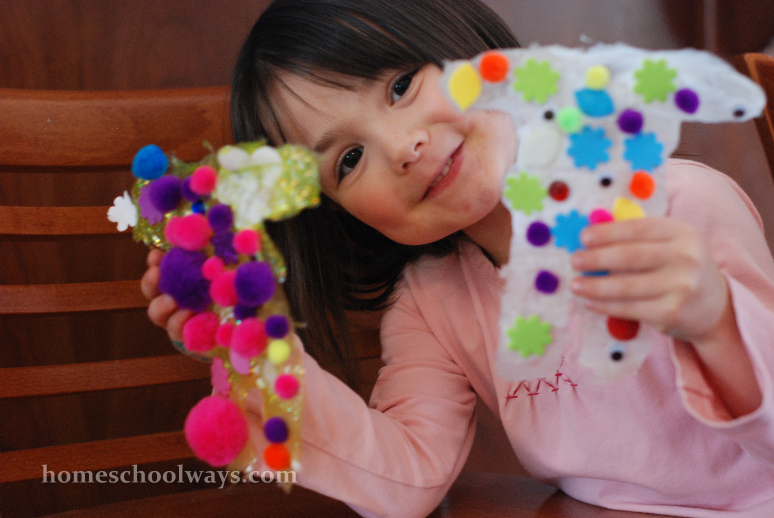
After reading them the book, we chose the activity called “Make a Mini Glue Suit.” The kids got to create their own glue suits, reminiscent of what happened to the main character of Too Much Glue (affiliate link).

Reading helped me ease into the world of science. Reading to the kids, I like. Doing science experiments, getting all gluey and gooey, not so much. But I survived to tell the fun story.

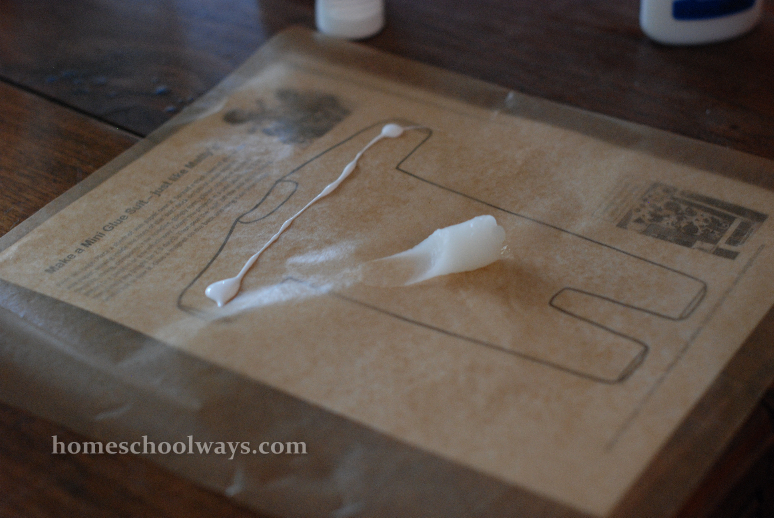
Each of them worked on a glue suit by pouring as much glue as they wanted on wax paper, which I had taped over their handout. The only rule was that they had to stay within the lines of the outline on the handout. Next, it was time to decorate with pom-poms and stickers. Lastly, we had to wait. Not three minutes, but three days. We are talking a lot of glue here.

They were very proud of their glue suits and they enjoy seeing them on a shelf in the play area. The other activities involve testing different formulas for glue and we plan on working on them next year. By then, the kids will get older and words like polymer, cohesion and adhesion will be easier to pronounce.

Elmer's School Glue vs. Elmer's Natural Glue

School glue pours and natural glue spreads like a paste.

We finished by reading the story of Elmer, the mascot of this company. The story starts way back in 1857 when Gail Borden started Borden Company. At the time, they produced dairy, ice cream, pastries and pasta. By the early 1900s, the Borden Company found out they could make glue out of casein, a milk protein. Their first glue product, Casco Glue, was introduced in 1932. After experimenting some more, in 1947, they made a perfect glue recipe out of synthetic materials – Elmer’s Glue-All.

Glue suits, inspired by the book "Too Much Glue"

Glue suits made and decorated by my children, according to the book “Too Much Glue”

Elsie the cow was the mascot of the Borden Company for many years, but American families knew her husband, Elmer, quite well, too. By 1940, when Borden needed a new mascot at the World’s Fair, Elmer replaced his wife and the rest is history.

Today, Elmer’s picture is on more than 150 types of glue bottles and other products. Children and adults alike recognize him.

Connect with Elmer’s on Twitter and Facebook and Pinterest. Here’s a free lesson plan from Elmer’s Glue.

To enter the giveaway, you must be an email subscriber to Homeschool Ways (see sign up form on the right hand column, under the FREE ebook). You have until April 10, 2014. April 15 Update: Denisa from Canada won this.

Get some glue out and craft something. Your homeschool will benefit from a few giggles and sticky fingers. I think. I know mine did.


Mango Languages Review

Posted on

When it comes to learning foreign languages in our homeschool, I feel right at home. No pun intended. As a polyglot, I naturally want my children to pick up as many languages as possible. You know how some people want their children to learn piano AND violin? I want my children to speak several languages.

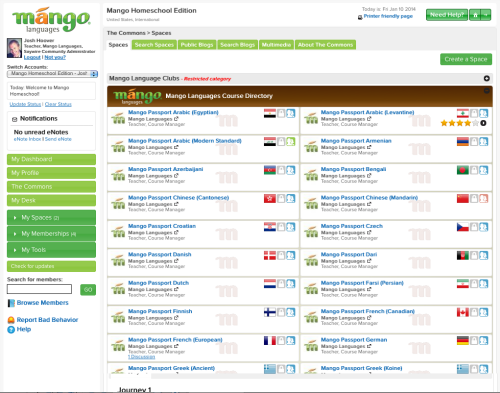
They are bilingual to start with, so why not add a few more languages to their repertoire? Enter Mango Languages, an online language learning program. Featuring 60+ languages, the Mango Homeschool Edition can help your homeschoolers pick up a language by immersion. I like the fact that they employ native speakers. You can really tell the difference.
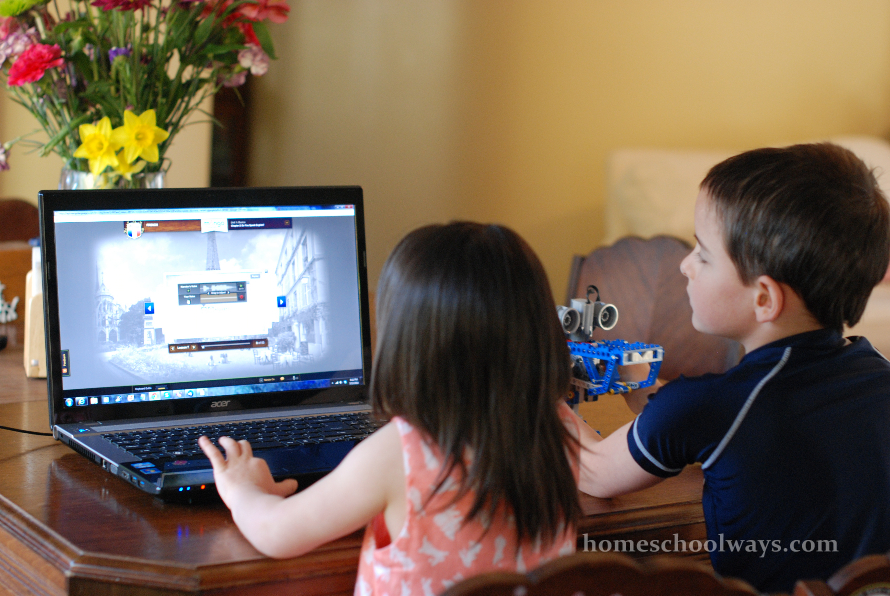
Mango Languages recording feature used by children

My son and daughter loved the recording feature of Mango Languages. They got really silly with it, but I allowed it because I remember acting silly when I first took language lessons, too.

Once you decide which package will work for your family and purchase it, they will provide you with login information for every student. Of course, parents can learn, too. My children are taking French, Spanish, Latin, and Romanian. I am studying Italian and brushing up on my Latin.

Here are the price packages available:

1 subscription is $18/month or $125/year total
2 subscriptions is $28/month or $175 /year total
3 subscriptions is $38/month or $225/year total
4 subscriptions is $48/month or $275/year total
5 subscriptions is $58/month or $325/year total

Anything over 6 subscriptions is a special group rate that will depend on the number in the group. As far as homeschool curriculum goes, I think these prices are more than reasonable. The question is, once you have it, will you use it? That’s always the question, whether it’s a backyard pool or a book you bought at a seminar or a subscription to language learning online. But I digress.

Personally, I am already trying to immerse my children in other languages. As we live our lives, I speak to them in Romanian. When daddy is around and he has to understand what I am saying to the kids, I switch to English. However, I read to the children in English, Romanian, French and Spanish, depending on the books they pick. I also mention to them several things in French and Spanish as we go through the day.

Mango Languages Review

It’s really random, as these idioms strike my fancy. So I used Mango to organize our language instruction. The kids loved it in the beginning. It was a new experience. It was computer time. They don’t get much screen time (TV or computer) because I don’t believe it is good for their brains. Besides, they will spend their adult lives in front of screens, so I want their early school years to be as low-tech as possible.

Over time, they started getting bored with it. Mango Languages is pretty much a set of virtual flash cards that get repeated so you can get drilled. By repetition, you can store up vocabulary in your long-term memory. You know what they say, “Repetition is the mother of learning.”

This is the screen you should see once you are logged in. The directory of languages looks impressive, doesn’t it?
Mango Languages Review

I love Mango Languages because I am motivated to learn languages. But, if the why is not strong enough, the how will not follow.

That’s where the going gets tough. Do you have the mental fortitude to continue, once the newness wears off? With my kids being so small, I did not enforce instruction if they did not want to do Mango Languages on a particular day.

Even so, I dare say they learned quite a bit. And so did I. If nothing else, all this language immersion, whether by me, at random, or systematically, through Mango Languages, has trained them to wonder how we say something in another language. Now and then, throughout the day, they ask me, “How do we say this in French (or Spanish, or Romanian)?” You know they want to learn when they ask questions.

I first thought we should study only French and Spanish. Then, I thought I should look into Latin, as well. Just to show them how close it is to Romanian and some of the things they already know in French and Spanish.The children asked for Romanian, too, taking me by surprise. It was fun to sit there and listen to my mother tongue being drilled into my children. As if they don’t get enough of it daily. But it was neat for them, I think, to get Romanian from somebody other than mommy.

Personally, I appreciated the grammar notes. I love grammar, so any bit of grammar I get helps me with my database of knowledge about what is or isn’t acceptable in a language. The other thing that I took great pleasure in was the explanations of the literal translation in different idioms.

We say, “What’s up?” in English, but nobody looks up when you ask them that before they answer you, for instance. The same goes for other languages. Knowing the literal translation helps with creating the sentence – at least, for me. It also fascinates me to see how different cultures view the world. Where the English ask how you are, the French would ask how it is going, while the Romanians ask, “What are you doing?”

I did notice that some translation was a bit random. For instance, we do not say “What is your name?” in Romanian. We ask, literally, “What do they call you?” However, the answer can be, literally, “My name is…” or, “They call me…” So when the English version was “My name is…” and I wanted to translate, I used “They call me…” and it was wrong. They supplied the literal translation of “My name is…”

I suspect the same is true about other languages. I noticed it in French. Regardless, there is a lot of learning that goes on and, should you learn one way of saying things, you should count yourself blessed. At least, you know one way of expressing yourself in a different idiom.

There are tests and there is tracking coming up as they continue to develop this software. Personally, I am in awe of this whole experience, even in its beta version. One thing I have not done is get in touch with other people who study the same languages. There is a community with chat rooms one can take advantage of in the software, if you should feel so inclined.

Since my children are only four and six, I need to be there for technical support, for guidance, to help them navigate the different screens and to help with any questions. Older students would not need their hands held through the process though. The software is intuitive. The product is intended for ages six through adult.

By far, the best aspect of using Mango Languages for my children was the recording feature. The student listens to a native speaker pronounce a phrase. Then, the student can record her own voice pronouncing the same phrase. One can play both recordings simultaneously to really listen for differences in syllables, accent and pronunciation. My kids loved that feature.


Here are the social media links for Mango Languages:

Twitter: httpss://twitter.com/MangoLanguages
Pinterest: https://www.pinterest.com/mangolanguages/
Facebook: httpss://www.facebook.com/MangoLanguages

Crew Disclaimer
 

Click to read Crew Reviews


Mom Monday Week 10 – 5 Benefits of Home Cooking

Posted on

Raise your hand if you are tired of cooking. I know I am. When one homeschools, one could be at home most days, which means one does not have the excuse of eating out because of convenience. Putting two children in the car is a lot less convenient than boiling water for pasta and opening a jar of marinara sauce, know what I mean?

In my home cooking burnout, no pun intended, I reached for a simple solution: sandwiches. Nobody complains. Especially not the cook.

Mom Monday Series - 5 Benefits of Home Cooking

As I recover from my boredom and re-discover the joy of cooking, I have to keep in mind that home cooking does have advantages over eating out. In no particular order…

1. Home cooked food is healthier than restaurant food. Research has shown that home cooked meals contain less fat and sugar than their restaurant counterparts.  Continue reading »