Mom Monday Week 12 – Visualize Your Success

Posted on

Professional athletes, high-powered CEOs, and the world’s best entertainers know a few secrets to success: passion, perseverance, hard work, a bit of luck, and visualization – among other things. I would like to zoom in on visualization for this week’s Mom Monday post. Homeschooling moms prepare for success, too. Why not learn from these accomplished individuals?

Homeschooling moms can visualize their success especially before a stressful days

Homeschooling moms can learn from successful people who visualize their stressful days ahead in a calm, positive way

First, a definition. Visualization is the formation of mental visual images. You may have seen skiers waiting to start their course visualizing themselves on the slopes, moving their shoulders left and right based on where they see themselves being, and bending their knees accordingly. The night before a big match, tennis players and other athletes also spend time visualizing themselves at key points in the game, applying strategies they have practiced and discussed with their coaches.

Why do they do that? Their muscles are ready. They are preparing their minds. Victory takes complete dedication. Training the muscles is not enough. One must train the mind to think victory.

Mom Monday Week 12 Visualize Your Success

In the same way, a homeschooling mom should visualize herself being successful in rearing her children. I believe prayer and meditation based on God’s Word provide an opportunity for visualization. As we claim the promises of God over our children, we can visualize them accepting Jesus as a personal Savior, passing exams with high grades, and making the right choices in every aspect of their lives. But visualization is more about your own behavior.  Continue reading »


Homeschool Parent Support Night

Posted on

Once a month, homeschooling moms in Sevier County get together in a hospitable home in Pigeon Forge. We bring something to munch on and we have a good time talking.

Sometimes there are 15 of us and the room gets noisy. Other times there are only four of us. That’s when the conversations get deeper and trouble spots work their way into the conversation. “How do you know you are doing enough?” “What if my son is two grades behind?” “How can I make myself stop from worrying?” and many other similar questions come up.

What strikes me is that homeschooling moms really have the same questions as public or private school moms. Sure, we have a few additional questions about curriculum choices, umbrella schools and dealing with negative people in our lives. Besides that, it all goes back to parenting.

“Are you already praying for your son’s future wife?” somebody asked me. I answered in the affirmative. “Since he was born.”

We don’t see each other between meetings. We are all too busy and scattered across our county to get together. Maybe we should make an effort. Maybe not. I find that many homeschooling families uphold standards they are proud of. But they are all different. While we respect each other’s freedom of choice, we just don’t want to impose our standards on others. And getting to know what somebody wants to do with their children takes time. Who’s got any extra these days?

“Who is your best girl friend and does she support your decision to homeschool?” I was relieved to find out other moms confessed they did not have a “best friend.” Neither do I. When you are married with children, there’s no time for a BFF. There, I said it. But my close friends do support my decision to homeschool. They even homeschool themselves. They just don’t live nearby. I wish they did. But life has spread us all over the world after college and now we stay in touch as well as we can.

The friendship of my local homeschooling support group means a lot to me. I get refreshed and encouraged every time. I am thankful to the hostess and the group leader who keep us all going.


Mom Monday Week 11 – Mommy and Me

Posted on

Can you believe one fifth of this year has become a memory already? Time flies when you’re having fun homeschooling.

The rain threatened to ruin our Sunday, but I made an effort to stay positive yesterday. I took time to play “Bible Go Fish” and “Sorry” with the kids. They squeal with delight as they tell each other to go fish. I try to focus on that and be mommy, even though I take mental notes of their counting and matching skills.

Little girl with dolly

My daughter with her baby doll

My son was reading the cards while waiting for his sister to check her cards for what he asked. These Bible Go Fish cards contain different reasons to thank God, from pets, to a loving family, to Jesus Himself. A cross-curricular activity indeed, if we needed to use education jargon to describe this game.  Continue reading »


The World of Glue – Elmer’s Teaching Toolkit Review and Giveaway

Posted on

Elmer’s Glue has put together a great cross-curricular investigation of adhesives for teachers to share with their students. There are so many different kinds of glues and they can be obtained in so many different ways. If you create a free homeschool teacher account on their site, you will have access to this and many other tools to teach science, as well as a host of other activities to students of all ages.

Elmer's World of Glue Toolkit

Elmer’s World of Glue Toolkit for Teachers offers a cross-curricular set of activities for K-5 students

Elmer’s Glue sent me this toolkit for free and I was asked to write an honest review and not necessarily a positive one. The kit is called “The World of Glue” and it came with:

  • a great book, Too Much Glue, by Jason Lefevre – this picture book introduces us to a boy who enjoys glue a bit too much, to the point where he gets dressed up in a suit made of glue;
  • a teacher’s manual, which contains five activities and four extension activities, plus handouts and student activity pages;
  • three bottles of glue: a natural one (which is not runny and quickly became my favorite one – I found out it is made out of natural ingredients, American-grown corn being the main one), school glue (first introduced on the market in 1967 – the formula stuck!), and glitter glue (my daughter’s favorite).

After reading them the book, we chose the activity called “Make a Mini Glue Suit.” The kids got to create their own glue suits, reminiscent of what happened to the main character of Too Much Glue (affiliate link).

Reading helped me ease into the world of science. Reading to the kids, I like. Doing science experiments, getting all gluey and gooey, not so much. But I survived to tell the fun story.

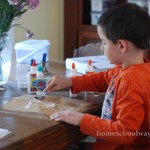
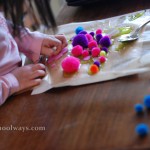
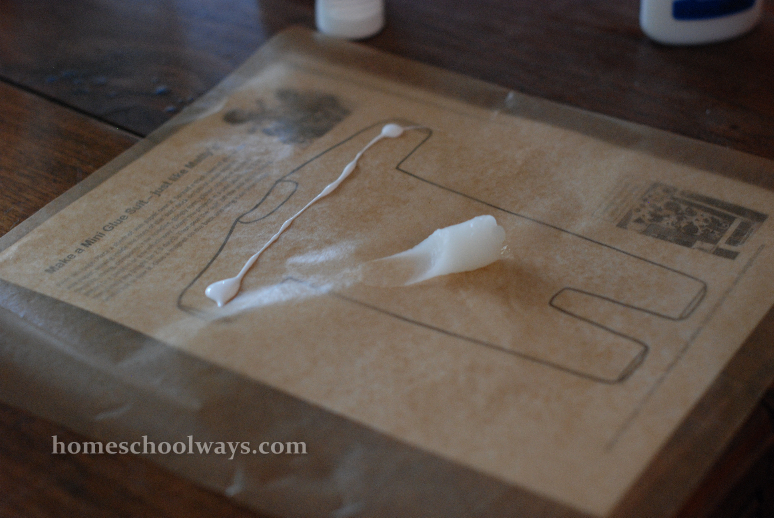
Each of them worked on a glue suit by pouring as much glue as they wanted on wax paper, which I had taped over their handout. The only rule was that they had to stay within the lines of the outline on the handout. Next, it was time to decorate with pom-poms and stickers. Lastly, we had to wait. Not three minutes, but three days. We are talking a lot of glue here.

They were very proud of their glue suits and they enjoy seeing them on a shelf in the play area. The other activities involve testing different formulas for glue and we plan on working on them next year. By then, the kids will get older and words like polymer, cohesion and adhesion will be easier to pronounce.

Elmer's School Glue vs. Elmer's Natural Glue

School glue pours and natural glue spreads like a paste.

We finished by reading the story of Elmer, the mascot of this company. The story starts way back in 1857 when Gail Borden started Borden Company. At the time, they produced dairy, ice cream, pastries and pasta. By the early 1900s, the Borden Company found out they could make glue out of casein, a milk protein. Their first glue product, Casco Glue, was introduced in 1932. After experimenting some more, in 1947, they made a perfect glue recipe out of synthetic materials – Elmer’s Glue-All.

Glue suits, inspired by the book "Too Much Glue"

Glue suits made and decorated by my children, according to the book “Too Much Glue”

Elsie the cow was the mascot of the Borden Company for many years, but American families knew her husband, Elmer, quite well, too. By 1940, when Borden needed a new mascot at the World’s Fair, Elmer replaced his wife and the rest is history.

Today, Elmer’s picture is on more than 150 types of glue bottles and other products. Children and adults alike recognize him.

Connect with Elmer’s on Twitter and Facebook and Pinterest. Here’s a free lesson plan from Elmer’s Glue.

To enter the giveaway, you must be an email subscriber to Homeschool Ways (see sign up form on the right hand column, under the FREE ebook). You have until April 10, 2014. April 15 Update: Denisa from Canada won this.

Get some glue out and craft something. Your homeschool will benefit from a few giggles and sticky fingers. I think. I know mine did.


Mango Languages Review

Posted on

When it comes to learning foreign languages in our homeschool, I feel right at home. No pun intended. As a polyglot, I naturally want my children to pick up as many languages as possible. You know how some people want their children to learn piano AND violin? I want my children to speak several languages.

They are bilingual to start with, so why not add a few more languages to their repertoire? Enter Mango Languages, an online language learning program. Featuring 60+ languages, the Mango Homeschool Edition can help your homeschoolers pick up a language by immersion. I like the fact that they employ native speakers. You can really tell the difference.
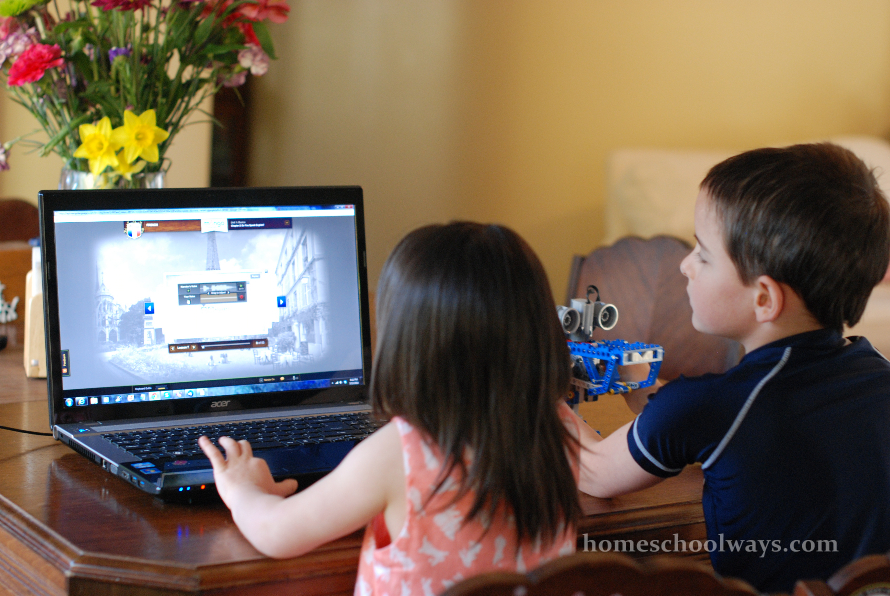
Mango Languages recording feature used by children

My son and daughter loved the recording feature of Mango Languages. They got really silly with it, but I allowed it because I remember acting silly when I first took language lessons, too.

Once you decide which package will work for your family and purchase it, they will provide you with login information for every student. Of course, parents can learn, too. My children are taking French, Spanish, Latin, and Romanian. I am studying Italian and brushing up on my Latin.

Here are the price packages available:

1 subscription is $18/month or $125/year total
2 subscriptions is $28/month or $175 /year total
3 subscriptions is $38/month or $225/year total
4 subscriptions is $48/month or $275/year total
5 subscriptions is $58/month or $325/year total

Anything over 6 subscriptions is a special group rate that will depend on the number in the group. As far as homeschool curriculum goes, I think these prices are more than reasonable. The question is, once you have it, will you use it? That’s always the question, whether it’s a backyard pool or a book you bought at a seminar or a subscription to language learning online. But I digress.

Personally, I am already trying to immerse my children in other languages. As we live our lives, I speak to them in Romanian. When daddy is around and he has to understand what I am saying to the kids, I switch to English. However, I read to the children in English, Romanian, French and Spanish, depending on the books they pick. I also mention to them several things in French and Spanish as we go through the day.

Mango Languages Review

It’s really random, as these idioms strike my fancy. So I used Mango to organize our language instruction. The kids loved it in the beginning. It was a new experience. It was computer time. They don’t get much screen time (TV or computer) because I don’t believe it is good for their brains. Besides, they will spend their adult lives in front of screens, so I want their early school years to be as low-tech as possible.

Over time, they started getting bored with it. Mango Languages is pretty much a set of virtual flash cards that get repeated so you can get drilled. By repetition, you can store up vocabulary in your long-term memory. You know what they say, “Repetition is the mother of learning.”

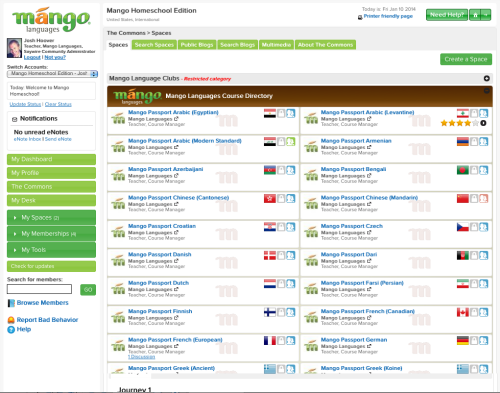
This is the screen you should see once you are logged in. The directory of languages looks impressive, doesn’t it?
Mango Languages Review

I love Mango Languages because I am motivated to learn languages. But, if the why is not strong enough, the how will not follow.

That’s where the going gets tough. Do you have the mental fortitude to continue, once the newness wears off? With my kids being so small, I did not enforce instruction if they did not want to do Mango Languages on a particular day.

Even so, I dare say they learned quite a bit. And so did I. If nothing else, all this language immersion, whether by me, at random, or systematically, through Mango Languages, has trained them to wonder how we say something in another language. Now and then, throughout the day, they ask me, “How do we say this in French (or Spanish, or Romanian)?” You know they want to learn when they ask questions.

I first thought we should study only French and Spanish. Then, I thought I should look into Latin, as well. Just to show them how close it is to Romanian and some of the things they already know in French and Spanish.The children asked for Romanian, too, taking me by surprise. It was fun to sit there and listen to my mother tongue being drilled into my children. As if they don’t get enough of it daily. But it was neat for them, I think, to get Romanian from somebody other than mommy.

Personally, I appreciated the grammar notes. I love grammar, so any bit of grammar I get helps me with my database of knowledge about what is or isn’t acceptable in a language. The other thing that I took great pleasure in was the explanations of the literal translation in different idioms.

We say, “What’s up?” in English, but nobody looks up when you ask them that before they answer you, for instance. The same goes for other languages. Knowing the literal translation helps with creating the sentence – at least, for me. It also fascinates me to see how different cultures view the world. Where the English ask how you are, the French would ask how it is going, while the Romanians ask, “What are you doing?”

I did notice that some translation was a bit random. For instance, we do not say “What is your name?” in Romanian. We ask, literally, “What do they call you?” However, the answer can be, literally, “My name is…” or, “They call me…” So when the English version was “My name is…” and I wanted to translate, I used “They call me…” and it was wrong. They supplied the literal translation of “My name is…”

I suspect the same is true about other languages. I noticed it in French. Regardless, there is a lot of learning that goes on and, should you learn one way of saying things, you should count yourself blessed. At least, you know one way of expressing yourself in a different idiom.

There are tests and there is tracking coming up as they continue to develop this software. Personally, I am in awe of this whole experience, even in its beta version. One thing I have not done is get in touch with other people who study the same languages. There is a community with chat rooms one can take advantage of in the software, if you should feel so inclined.

Since my children are only four and six, I need to be there for technical support, for guidance, to help them navigate the different screens and to help with any questions. Older students would not need their hands held through the process though. The software is intuitive. The product is intended for ages six through adult.

By far, the best aspect of using Mango Languages for my children was the recording feature. The student listens to a native speaker pronounce a phrase. Then, the student can record her own voice pronouncing the same phrase. One can play both recordings simultaneously to really listen for differences in syllables, accent and pronunciation. My kids loved that feature.


Here are the social media links for Mango Languages:

Twitter: httpss://twitter.com/MangoLanguages
Pinterest: https://www.pinterest.com/mangolanguages/
Facebook: httpss://www.facebook.com/MangoLanguages

Crew Disclaimer
 

Click to read Crew Reviews


My Father’s World Curriculum Expo

Posted on

When: March 24, 2014, 11:00AM – 3:00PM

Where: Hilton Garden Inn in Knoxville (West Cedar Bluff), 216 Peregrine Way Knoxville, TN 37922

What: My Father’s World Curriculum Expo, i.e. a free opportunity to take a look at their curriculum. A staff family will answer your questions and take orders.

How: Register for the event and receive your $10 coupon. Click on the button below.

learn more
During the pre-registration process you will also have the opportunity to share this event with your friends on social media.


Mom Monday Week 10 – 5 Benefits of Home Cooking

Posted on

Raise your hand if you are tired of cooking. I know I am. When one homeschools, one could be at home most days, which means one does not have the excuse of eating out because of convenience. Putting two children in the car is a lot less convenient than boiling water for pasta and opening a jar of marinara sauce, know what I mean?

In my home cooking burnout, no pun intended, I reached for a simple solution: sandwiches. Nobody complains. Especially not the cook.

Mom Monday Series - 5 Benefits of Home Cooking

As I recover from my boredom and re-discover the joy of cooking, I have to keep in mind that home cooking does have advantages over eating out. In no particular order…

1. Home cooked food is healthier than restaurant food. Research has shown that home cooked meals contain less fat and sugar than their restaurant counterparts.  Continue reading »


Great Homeschool Conventions

Posted on

Are you going to a homeschool convention this year? Which one? Please leave me a comment.

Check out the homeschool event of the year, with speakers like Dr. Ben Carson, Susan Wise Bower and Heidi St. John, among others.

This post contains affiliate links, which means that you can buy a ticket for this conference at no extra cost to you and I receive a small percentage. Thank you for your support!

Homeschool Convention Discount Ticket Price Extended


Get Outside and Learn – 3 Ideas

Posted on

Remember when it was the end of the school year with summer vacation right around the corner? Sitting inside the classroom at your desk, swinging your feet back and forth, itching to get outside and play? And then the teacher said, “Let’s have class outside for an hour this afternoon,” and you couldn’t believe it! She ushered everyone into a line, your heart beating wildly and your little feet shuffling back and forth. You couldn’t wait to plop down on the soft, warm grass and listen to your teacher read a story. Under her arm she held just one book and you secretly hoped that she would just read one story and then let you run around with your friends, enjoying the warm sun on your bare arms.

Children running outside

Let them expand their energy outside in the fresh air

If there was ever a word to describe this feeling it is freedom. And, as a homeschool mom, you can give your kids (aka students) this sense of freedom right in your backyard, at the local park, or anywhere else where learning and outdoors collide.

In other words, get outside and learn! Whether you take your math class outside by counting the trees, flowers, birds or airplanes or science, by studying the life thriving around you, you’re guaranteed to see your students thrive as well. Here are three tips for taking your class outside.

1. Plan Ahead

Being spontaneous is a great freedom trait, but so is planning ahead. By letting your students know when, where, and why they are having class outside, they know what to expect. And giving kids expectations (where you set the rules) will help them prosper. Planning ahead will also avoid wasted time.

2. Use Outside Class as a Reward

Use outside class as part of a reward system. For example, when your students have achieved certain milestones you have set and it’s time to reap the rewards, offer outside class as one of the reward choices. Be clear about what constitutes an outdoor class session. It’s also ok to give added outdoor play as part of a reward – and a nice break for you, too!

3. Field Trips

Getting out of the classroom by going on an outdoor field trip really exposes your students to the world. If you live near a beach, go collect and classify seashells. If you live in the desert, go for a hike to lean about different kinds of cacti. If you live in the city, visit an outdoor aquarium or zoo to learn about the different animals that inhabit our planet. Finish off the field trip over the next day or two with writing assignments or by using other measurement tools such as worksheets. Either way, let your students know what the assignment is before heading outdoors on an exciting field trip.

All in all, getting your students outdoors really gets them excited. By planning ahead and setting realistic goals and expectations for outdoor learning, you give your students the freedom to explore the world around them using all five senses. Outdoor learning, when done right, is one of the best ways to get your students actively learning.


Mom Monday Week 9 – What’s Your Giant?

Posted on

Have you spotted any of these Giants in the Promised Land of Homeschooling?

  • I don’t know which method to apply.
  • I have no idea which curriculum to pick.
  • I have no self-confidence.
  • Negative comments from family, friends and strangers bring me down.
  • I have no patience with my own children.

Remember what frightened spies said about the prospect of conquering the Promised Land? “And there we saw the giants, the sons of Anak, which come of the giants: and we were in our own sight as grasshoppers, and so we were in their sight.” Numbers 13:33

Mom Monday Week 9 - What Is Your Giant?

Allow me to paraphrase, please. Not only are these people giants, they “come of giants,” i.e. they have the DNA of giants. They walk like giants, they look like giants, they talk like giants, they fight like giants. But even if they don’t do anything like giants, their ancestors are giants, so we are to fear them anyway.  Continue reading »