Lego Quest and Homeschooling, Part 2

Posted on

Our lives revolve around LEGO building systems or so it seems. We use LEGO Education sets in our homeschooling efforts. Then, we use LEGO brick sets for any type of free play my children dream up.

I recently discovered a blog (now inactive) which provided a list of 52 LEGO challenges – one for every week of the year. You may have seen my first post in this series. For other LEGO-related posts, please click here.

My son recently finished four more LEGO Quests and here they are.


LEGO Quest #7 – Collaboration

The idea is to work with at least one other person in creating a project, whatever that project might be. Well, we all pitched in. Daddy, mommy and little sister helped, but we let him come up with the idea.

Our son decided he wanted to build a home – which I thought was appropriate since we were all going to help him. Together, we built a home. Does anybody else see any symbolism in this?

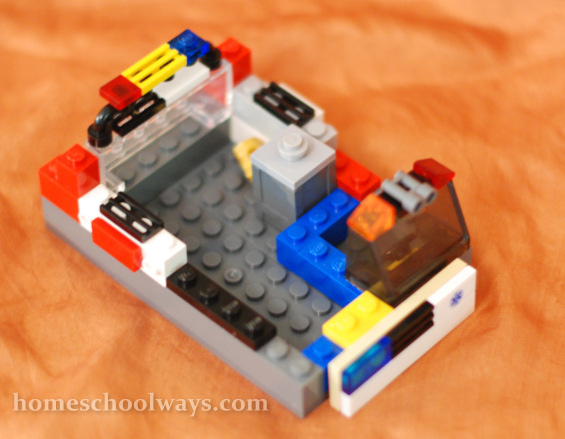
LEGO Quest Collaboration

LEGO Home


He and his sister decided to add a few more details to it.
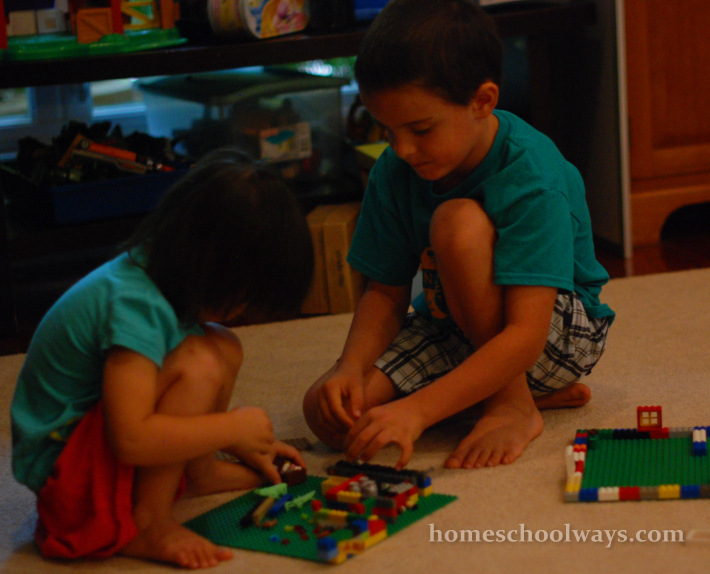
Finishing touches on his home, with his sister

Finishing touches on the LEGO home


LEGO Quest #8 – Your Favorite Book

It could be a character, scene, object or even a feeling from that book. He first chose the book, “Winnie the Pooh.” Then, he was stumped. I suggested a few things and he chose to make Winnie’s honey pot. There he is, taking a picture of his creation, while little sister is looking on.
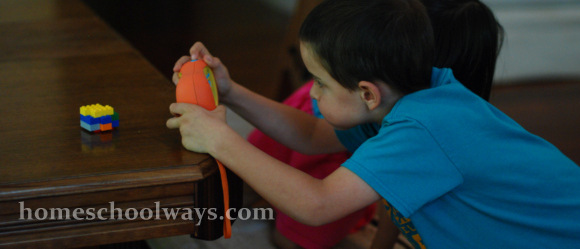
Taking a picture of his creation

Photographing his Winnie the Pooh honey pot


These days, my son is fascinated with counting to 100 by 10s. So he was asking for quest #10, then #20, then #30… Neither inspired him. We continued down the list of quests and we ran out. Finally, we decided to work on (almost) the last two.


LEGO Quest #50 – Macro Scale

The idea is to reproduce a brick or a plate in macro scale. He made a small tent and a big tent.
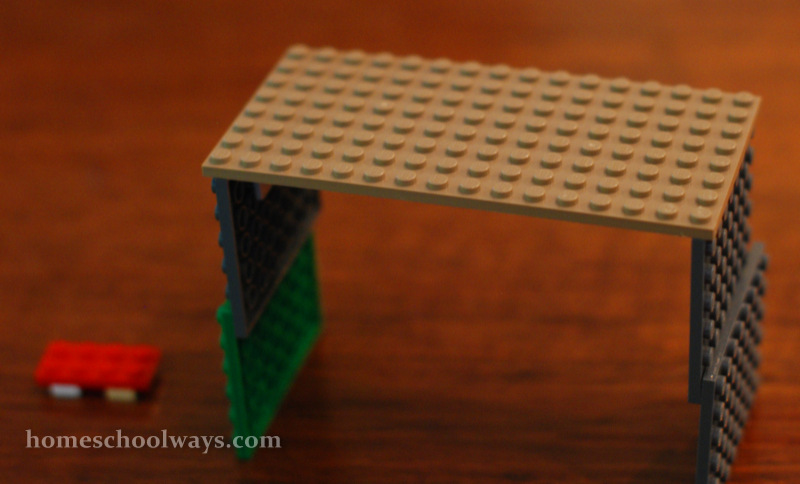
LEGO Tent Macro Scale

Macro scale LEGO tents


LEGO Quest #51 – Olympic Event

I reminded him what the Olympic Games are. We looked at the examples provided on the blog, but nothing inspired him. He decided to build a mini-golf course, probably inspired by our latest putt-putt game.

Notice the attendant ready to give out golf clubs (leaning against red bricks in the attendant’s box) and golf balls (in the yellow box). I know, I know, putt-putt is not an Olympic game yet, but maybe it should be, for the sake of five-year-old boys and girls all over the world.
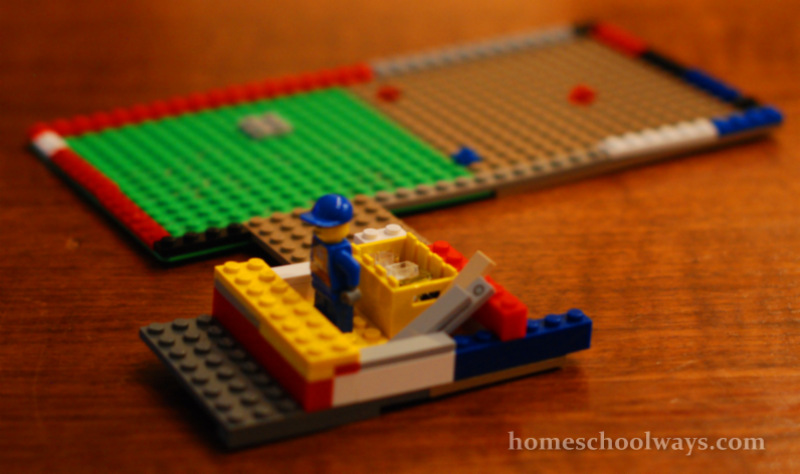
LEGO Mini-Golf Course and Attendant

LEGO putt-putt attendant and course in the background


And the Winner Is…

Posted on

… Mitzi Hendrich of Maryville. Congratulations, Mitzi! The Dollywood tickets are coming your way. Dollywood is a great homeschooling field trip – not just an amusement park. In some areas, it’s like stepping back in time 100 years. What a great way to learn American history.

Announcing the winner of a Dollywood ticket giveaway

In case you don’t know what I am talking about, I am giving away two Dollywood tickets to a blog subscriber. More information here.

Happy homeschooling!


How to Come Up with 4 Hours of Homeschooling Kindergarten

Posted on

{Today is the last day to enter to win 2 FREE Dollywood Tickets. See right menu for information.}

Some states ask homeschoolers to perform four hours of instruction in each of the 180 days of school they must report at the end of the school year. Tennessee, where I live, is one of those states.

State officials do not ask for specifics on what we did each day during those four hours. However, for my own sake, I keep tabs on what we do daily and how long each activity took. I use a simple notebook on each child, even though my daughter is in preschool and, as such, her instruction is not “official.”

Now, let’s define instruction. Any time knowledge is imparted, instruction happens. Children do not receive instruction only if they are seatead at a desk with their textbooks opened at a specific page as directed by an adult licensed as a teacher, who is standing in front of a blackboard or white board or SMART interactive board.

Children learn all the time. It’s what children do. They learn. They haven’t been around much, so most of what they see around them is new and exciting. Our task as parents is to surround them with positive, age-appropriate sources of information, according to their learning styles.

My daughter, a preschooler, joins us for most activities, so I use plural when I describe what we do. Here’s how I come up with four hours of instruction for my son, who is in homeschool kindergarten.


First Hour

30 minutes – Bible. This represents both our morning and evening devotional times, during which we read stories from age-appropriate Bible curriculum, learn hymns and praise songs, memorize passages of Scripture, pray, and do crafts or activities that will solidify and make real the knowledge of God. This time also covers those precious moments throughout the day when we talk about God because they ask about life and I direct their minds to the truths of the Bible.

30 minutes – Home Ec. Think making the bed, taking dirty clothes to the hamper, putting toys and school supplies up at the end of the day, dusting, wiping the table after meals, doing laundry, setting the table, stirring the oatmeal I cook for breakfast, pouring flour from the measuring cup into the mixing bowl for pancakes, pushing buttons on the blender filled with yummy ingredients under my supervision, learning to mow with daddy, emptying the dishwasher… I could go on and on. Home ec. skills are life skills which establish habits that will make them great spouses and parents and responsible adults with healthy self-images. Instruction happens throughout the day in small bits. I have approximated this to be half an hour daily.


Second Hour

1 hour – Romanian (mother tongue). I speak with them in Romanian 90% of the time I am with them. I also read to them in Romanian. It adds up to more than one hour a day, but I keep it simple for recording purposes.


Third Hour

30 minutes – Recess. Why not? If they count it as school time in public schools, we can, too.

30 minutes – Reading with mommy. I read picture books and various readers to them. We worked our way through “Before Five in a Row” and SimplyCharlotteMason.com reading lists. Now we are working through “Books Children Love.” Sometimes I have my son read a page or a whole reader, depending on how motivated he feels that morning.

Fourth Hour

30 minutes – P.E. Every day, as long as it is over 46F and dry, my children spend time outside on their bikes or doing various ball activities with me or with each other. Today we played a bit of tennis, for instance. Catching, throwing, rolling, and bouncing a ball are important large motor skills. Some days they bike the Gatlinburg trail. Daddy and I run alongside them. It is four miles both ways and we do it in 70 minutes, including a five-minute break when we turn around at Sugarlands Visitor Center. Great cardio workout. When it’s warm, we go to the pool. Every other month, they take swim lessons.

30 minutes – The 3Rs, i.e. formal instruction in reading, writing and arithmetic. Ten minutes per subject is plenty for a five-year-old. A child’s attention span is their age in minutes plus one. So a three-year-old can focus for about four minutes and a five-year-old for about six minutes. I make sure I don’t push my son beyond his limits. We might take a break and talk about something (he always has a story to share) before we go on to the next concept. We will probably do fifteen minutes per subject in the second semester; by then, my son will be six.


Fifth Hour

30 minutes – Reading with daddy. This is a nightly routine which happens after supper and just before bedtime.

10 minutes – Music. I play classical music for them throughout the day, during meals, or in the car. If they are interested, I tell them it is Telemann or Handel or Mozart etc.

10 minutes – Arts & Crafts. They make cards for different events and people on a regular basis. They draw, cut and paste in their lapbooks. They decorate their bedroom according to their fancy with old ribbons and scotch tape. They paint. They draw with chalk in the driveway.

10 minutes – Science. Once a month, they take a class at Ripley’s Aquarium. Nature walks or simply being in the yard provide an opportunity for spotting insects and animals. We melt ice. We make popsicles. We grow butterflies out of caterpillars we mail ordered. We write in our nature journals. We learn to cook and can and garden.

10 minutes – Foreign Languages. I tell them things in French and Spanish every day. Simple things. “Thank you” or “here you are” or “please” or whatever simple phrase I may use in Romanian, I repeat it in French. Or Spanish. Or English. I find myself saying the same thing in three or four different ways. Sometimes I make them repeat it, but other times, if we are hard at play, I just say it and we move on. We also repeat the days of the week and the months of the year in several languages for our calendar activities.

As you can see, I easily come up with more than five hours of “instruction” per day. Which means that I can leave out certain activities based on what we have on our schedule as a family that particular day. Activities can carry over for recording purposes, too. It works out well. I told you homeschooling was a flexible endeavor.


Homeschooling and Multilingualism

Posted on

Before I say anything about the languages that I speak and teach to my children, let me make it clear that if I don’t have love (i.e. the genuine article, a.k.a. agape in Greek), I am only a resounding gong or a clanging cymbal and who wants to do that for a living? Not me. Not in my home. Not in our homeschooling process.

If that gong and cymbal comparison sounds familiar, it’s because it is. I got it from a gentleman who spoke several languages himself and wrote a dozen small books which have been translated into many, many languages. I am referring, of course, to the Apostle Paul.

Comparing a loveless polyglot to a resounding gong is found in 1 Corinthians 13:1, to be precise. In this chapter, Paul talks about other accomplishments which mean very little in the absence of agape, but he starts out with multilingualism – a detail that has always resonated with me. Pun intended.

Having said all that, I must mention that am fluent in Romanian, French, and English. I have a good knowledge of Swedish, Spanish, Italian, and Latin. And I have basic knowledge of German, Norwegian and Portuguese. Here’s how…

I was born in Romania and lived there until I was 19. I took French in school (two hours a week, grades 5-12). I took English in school (two hours a week, grades 6-12). I also took Latin in the eighth grade. Two foreign languages plus Latin were mandatory subjects in Romania back then – not sure what they do now – but they did not have to be for me.

I have always loved languages and found it easy to learn words and grammar rules. Words to me are like toys to a child. I always want new ones.

Homeschooling and multilingualism

I majored in French and English at the University of Bucharest (UB). While there, I took Latin and Ancient French (Ancien Français) classes. It was incredibly helpful to see the evolution of French words from Roman times to the Middle Ages versus today.

Most people do not know that Romanian is a Romance language right along French, Italian, Spanish and Portuguese. We use the Roman alphabet, even though we are surrounded by nations who use the Cyrillic. So yes, I had some home advantage to all this language learning.

I learned Italian by watching Italian movies and TV – if you saw Michele Placido in La Piovra, you would, too – and by listening to Eros Ramazzotti’s music. It occurs to me that I have been a Ramazzotti fan since 1986 – almost three decades. His lyrics are deep poetry.

I learned Spanish on the go, during my lunch breaks in college, preparing for a mission trip to Ecuador in 1995. While there, immersion did the trick.

Swedish and Norwegian come from my three years of living in Sweden – I loved my Scandinavian period, especially the last year, when I lived in Stockholm. You might know this, Swedish vs. Norwegian is like British English vs. American English.

I took German classes here and there, from the TV, from conversation guides, from German friends. Swedish, Norwegian, German and English, of course, fall in the Germanic language family and the similarities help solidify new vocabulary.

Recently, I was watching an interview in Portuguese with English subtitles and I was relying heavily on reading the translation. At one point, I heard the words in Portuguese and the subtitles were delayed. I understood what was said and when the translation popped on the screen, it confirmed it. I tuned my ears and focused more. It was not hard to get it. I was very surprised, but I guess I should not be. Once you have most of the languages in one language family, it’s only a matter of imagination and fine tuning the endings of the words and some grammar rules.

My children are bilingual (Romanian and English) because daddy has always addressed them in English (he is American) and I have always talked to them in Romanian. I am working on adding French and Spanish to their repertoire. I sprinkle Latin here and there throughout the day, when I point out Latin roots of English words and how similar certain words are in many languages (e.g., rapid – English, rapid – Romanian, rápido – Spanish, rapide – French).

If my children went to “regular” school for seven hours a day, I would have very little time to expose them to other languages. That’s one of the big reasons why I chose to homeschool. Time. Time to pursue what we want, after we get basic academic skills out of the way.

For instance, the other day, we had to take a car trip right after breakfast to run an errand. We did our calendar and foreign language activities in the car. We said the days of the week and the months of the year in English, Romanian and French. Then, we counted to 20 in all three languages. I have written briefly about car schooling before.

That’s just another reason why I like homeschooling: learning happens everywhere you go, while you run errands and live your life together as a family, even when you are away from a desk. I linked to

Best4Future Wednesdays
Creative Kids Culture Blog Hop

Lego Quest and Homeschooling, Part 1

Posted on

My son loves LEGO bricks. I started him with DUPLO bricks when he was about two years old. By four, he was asking for LEGO bricks. His sister being two at the time, I had to make sure she would not put them in her mouth. We separated her DUPLO space from his LEGO space. It worked.

He is now five and builds projects that amaze me. I keep telling myself we need to send pictures of them to LEGO Club Jr. magazine. My daughter is three and a half now and she plays with LEGO bricks as well. In fact, my children usually play together and they mix the DUPLO and LEGO building systems into neat designs and intricate stories.

When I stumbled across LEGO Quest, I knew this would be a hit with my son. I did not even have to show him. He happened to pass by my laptop and spotted LEGO bricks on the screen. “What are you doing with that, mommy?”

I showed it to him. He was hooked. He did four quests in less than forty minutes. He would have done more, but it was time to start our bedtime routine.

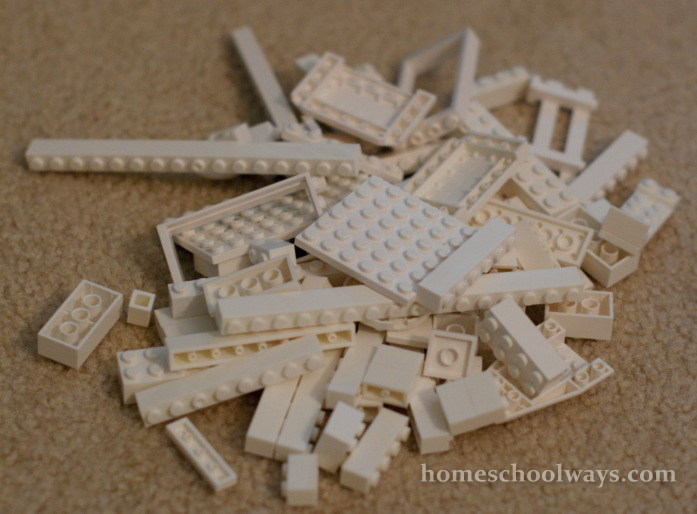
First, he did Quest 2: Monochromatic. He chose color white. His sister and I picked as many white bricks for him as we could until he said, “Stop. I have enough.”

LEGO Bricks Pile

White LEGO Bricks

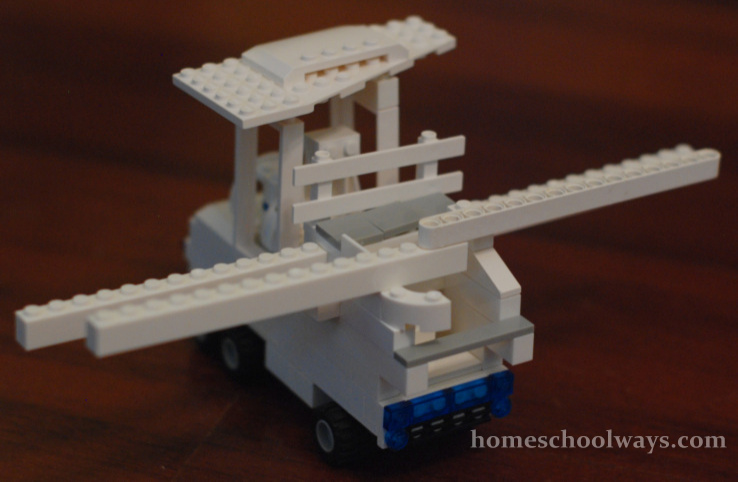
He started building and came up with this Mini Space Shuttle.

LEGO Mini Space Shuttle

LEGO Mini Space Shuttle

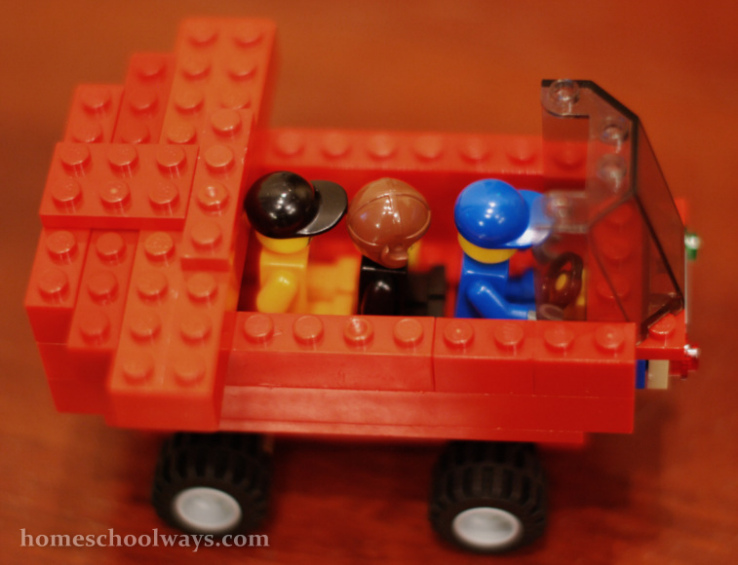
Then, he did Quest 1: Create A Car. He was bent on monochromatic even though I told him he could use as many colors as he needed. He chose red and came up with this car.

LEGO Car

LEGO Car

I was ready to call it a night, when he asked to do Quest 3: Vessel. I read the definition of vessel to him: boat, airship, bowl, cup, artery, vein (blood vessel), a person (a vessel of grace) etc. He chose to make a hovercraft. Here it is.

LEGO Hover Craft

LEGO Hovercraft

When I read LEGO Quest 4 (Two-dimensional) and LEGO Quest 5 (Tool) to him, he did not feel inspired. We moved on to Quest 6: Creature. He ran to the carpet where his LEGO stash was and came up with this.

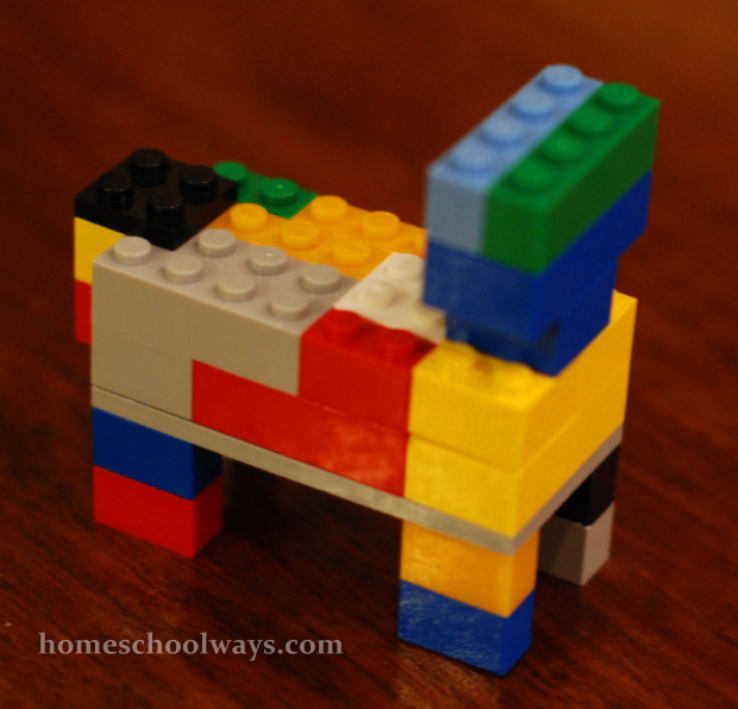
LEGO Rain Forest Bear

LEGO Rain Forest Bear

I asked him to tell me what it was, where it lived, and what it ate. He said it was a rain forest bear, it lived in the rain forest and that it rained a lot over there. Apparently, this creature eats trees, chipmunks, squirrels and cement. Before I could say anything, my son added, “Cement will not dry up in his belly.”

Here’s a picture of the four LEGO Quests he made last night.

LEGO Quest Creations

LEGO Quest Creations

I am not sure how many parts I will have to this homeschooling series, but a series it must be. It depends on how quickly he finishes the 52 LEGO Quests and how much we spread them over time. For other LEGO-related posts, please click here.


Dollywood Tickets Giveaway

Posted on

I am excited to announce my very first giveaway. Please look on the right side menu or read below for details.

You can enter to win 2 Dollywood tickets ($114 value) by simply signing up for email updates from this blog. The offer ends October 7. The winner will be announced in a special blog post on October 8.

Giveaway

These tickets can be used through December 31, 2013. Check the Dollywood schedule here.

Please spread the word especially if you have other homeschooling friends who would like to visit Dollywood before the end of this year.


26 Tips for an Easier Homeschooling Field Trip

Posted on

Two weeks ago we took three homeschooling field trips in one week. I have been shuttling small children to appointments for six years now. I have always used a mental checklist of things to look into before leaving the house. It seems I keep adding to it every time we go somewhere.

Now that I have a blog, I decided to write it all down. Here are my 26 tips for an easier homeschooling field trip:

1. Check the weather prognosis the night before. We have had cooler weather recently (63F) and so I figured I should wear long sleeves and long pants for the TVA Fair field trip. If I had known it was going to be 80F, I would have worn shorts and short sleeves.

2. Dress for the occasion. An event called “Down on the Farm” calls for sports shoes or boots. A science class at Ripley’s Aquarium, in air conditioning, might call for an extra layer, at least for me.

3. Download and print a venue map from their website. Familiarize yourself with the entrance(s), exit(s) and bathroom locations. These days, terrible things happen in malls, museums and other benign public places. Have the map handy while you walk around.

4. Check the schedule of the venue, especially if you are there for a shorter program. Do they close for lunch? Do they close for cleaning? The TVA Fair closed down the rides between 3-4pm. If I had known about it, we would have ridden a few rides first and then picnic.

5. Find out how to get ride tokens ahead of time. Knowledge is power. When you have to stand in line in the hot sun, it is good to know where the next token-selling booth is.

6. Check your gas tank the night before.

7. Pack changes of clothes and shoes for the children and for yourself. Children spill drinks all the time, sometimes on mommy.

8. Bring some reading materials as well as crayons and drawing pads. If you get stuck in traffic or if your destination is more than twenty minutes away, your children need to be occupied in the car. Mine like to thumb through pictures books and doodle.

9. Play classical music CDs in the car. It trains their ears to appreciate good quality music.

10. Think about investing in traveling pillows or use the ones from home. My children do not take a nap anymore at the house, but, occasionally, they fall asleep in the car.

11. Play CDs with stories or foreign language CDs. Do not underestimate car schooling.

12. Use sunscreen. If your field trip is mainly outdoors, have it handy so you can apply every two hours.

13. Wear hats with wide brims, if it’s sunny.

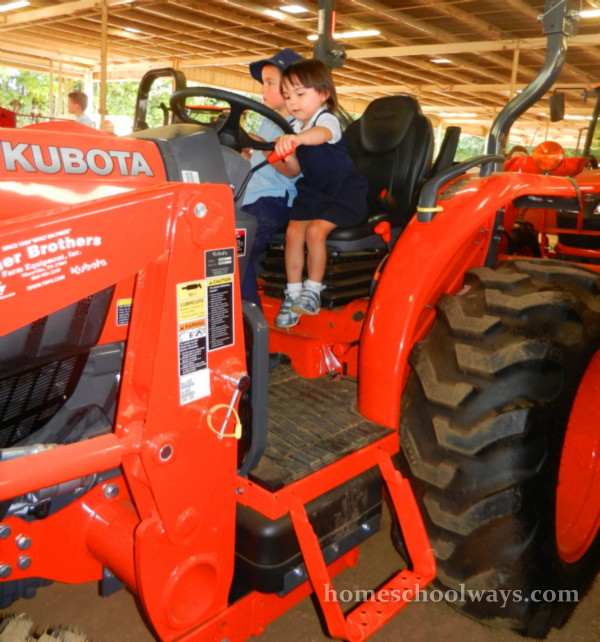
Tractor

My Children at the TVA Fair

14. Get rain gear – think small umbrellas or ponchos – if it’s overcast.

15. Take along their favorite stuffed animal, for the car.

16. Explain to the children ahead of time what the schedule will look like. If there is a gift shop and you do not want to buy anything, tell them so before you get there. Some places make you exit through the gift shop. When your children start asking for a cute stuffed pink octopus, you can remind them (and yourself) of your discussion.

17. Don’t forget your camera.

18. Ditch the purse. Carry a backpack instead.

19. Bring a stroller if you have a child under five.

20. Have cash on hand. You never know.

21. Bring business/calling cards. Sometimes you will meet new homeschooling moms on a field trip. It is hard to write down a phone number while supervising children running around. Producing a business/calling card out of your pocket is quick, easy and professional. Vistaprint.com is a great source for any type of cards.

22. Save the coordinator’s number in your phone so you can call her if anything comes up.

23. Pray before, during and after the trip, especially if you see everybody getting tired and cranky.

24. Watch your attitude. Your children will imitate you. If you are enthusiastic, they will be, too.

25. Give yourself fifteen extra minutes to get to your destination.

26. Don’t forget to have fun.

Homeschooling is such an adventure. I am stretching myself out of my comfort zone and embracing the challenge of field trips. Veteran homeschooling moms swear by them as educational opportunities, so I’d better learn to enjoy field trips quickly. What is your experience with field trips? Please leave me a comment below. This post is linked up to

Moms Mustard Seeds

Political Homeschool Field Trip

Posted on

When homeschooling small children, one must ponder before planning a field trip, “Is this really going to teach them anything? Or are we going to have to leave in the middle of the program?”

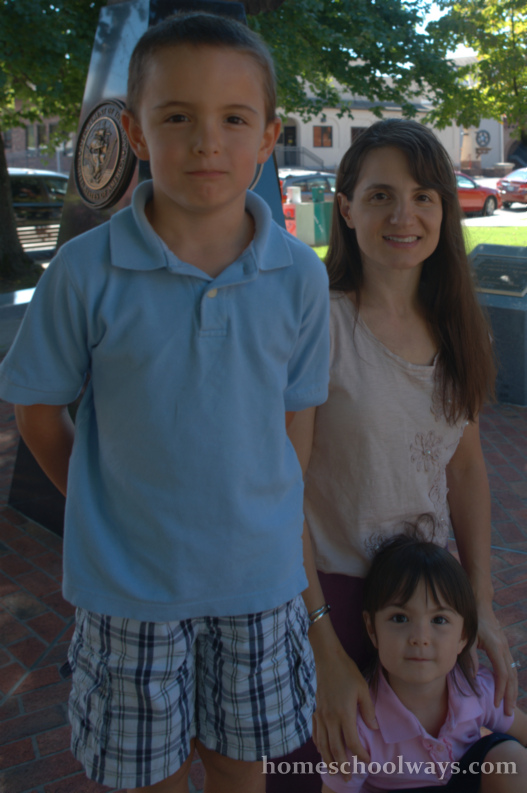
The Kids and I

The kids and I

Along those lines, you may think children under six do not get much out of a political field trip and you may be right. But we know children are constantly learning and internalizing their environment. So they must get something

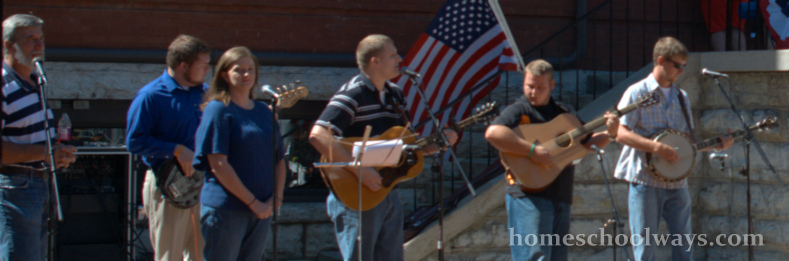
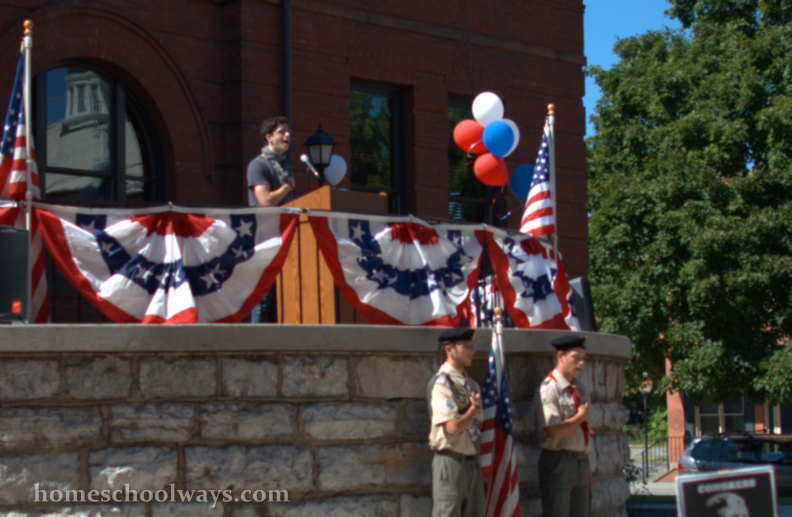
They hear the band before the speech, they see the flags, they listen to the national anthem. They hear a man speak and people clapping at certain points. They play with children they had never met before – socialization is no problem, of course. They enjoy the fresh air and the sunshine. Even if they do not pay attention, they get the idea that this event is special enough for mom and dad to attend it. It must be important.

The Band

The band

That is exactly what happened last week when we attended a political rally during which a Sevier County resident announced he was running for Congress. I could tell my children did not understand what happened exactly, but they knew it was important enough for us to be there.

Three-year-old Attends A Political Rally

Three-year-old attends political rally

To be fair, we do not know exactly what this candidate stands for, because we had to focus more on our children’s playing with other children to make sure nobody ran into the streets. The event was in downtown Sevierville, in front of the courthouse, and cars were everywhere. It actually felt like going to church, where we cannot get but bits and pieces of the sermon in between shushing our children.

I wanted to take my family to this event because I had never attended anything like this in person. I wanted to see how the kids would react to it, too.

The other reason we went was to support homeschooling mom Sabrina Gray, whose son got invited to sing the national anthem. He did a great job, too. He is one talented young man. Write his name down – Elijah Gray – because I think you will hear it again. He is a senior in high school and has been homeschooled all his life.

National Anthem

Elijah singing the National Anthem

This was the third of our field trips last week and I will be back to share some tips on how to make a homeschooling field trip easier on you and your students. I linked this post to


Join Me at The Homeschool Post!


Homeschooling Is Like Walking a Pony

Posted on

The second homeschool field trip we took last week was to the Exotic Petting Zoo in Sevierville. Of course, there’s always an incident when children visit a petting zoo. Two years ago, a camel nibbled on my son’s hand while he was feeding it. This year, my daughter got licked by a huge white horse which stretched over the fence to get to her head. It scared her and she cried, asking to leave right away.

My son started crying too, being afraid for his sister. I calmed them down by taking them to the zebra and emu area. They continued to have fun and even mustered enough courage to go inside the goat pen. I sent them in with my mom, because – how can I put it? – I am not exactly a goat pen fan. But my mom grew up on a farm and she enjoyed it.

However, when the children got pony rides, guess who had to hold the reins? My mom was afraid the ponies might kick the children off and she would not know what to do. I was “it” by default. Challenging, but I rose to the occasion.

The little tutorial they gave me in the beginning helps. They mentioned the ponies knew what to do. If they stopped, I was to pull gently on the rein.

They gave my son the biggest pony. After two rounds, when it stopped, I pulled on the rein to get it to go. It did not move. I looked at its back and realized what was happening. I explained to my son the pony was relieving itself and we waited patiently.

The smallest and oldest pony, age 22 ½, was deemed appropriate for my three-year-old daughter. It did fine for a bit, then it wanted to nibble on grass. I yanked the rein and it obeyed me. I got more confident and ended up enjoying the experience. I even wrote my next newspaper column in my head while I walked the course three times with each child.

Which made me think that walking a pony with a child on it is a lot like raising and homeschooling that child: scary, unpredictable, challenging, involving food and its elimination, and, well, sometimes you have to yank the rein gently to keep them on the right track. In the process, if you can relax, you can have fun and do some writing, too. This post is linked up to

Join Me at The Homeschool Post!


Down on the Farm Field Trip

Posted on

Last week, we took not one, not two, but three field trips. We are involved in three homeschool support groups. We pick and choose different activities each group does based on our interests, ages, and calendar.

It just so happened that last week all three groups organized a field trip we were interested in. I will tell you all about them in the next three blog posts, this being the first one.

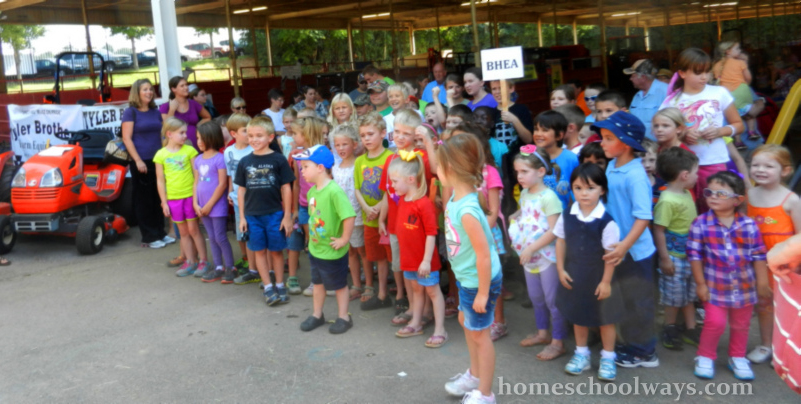
We went to the TVA Fair in Knoxville for a program called “Down on the Farm” with our Blount Home Education Association (BHEA) support group. For this particular event, 234 participants signed up. Yes, that was a large group. Glad I was not the organizer.

Once I registered online for this field trip, I received the instructions:

(1) park in the field in front of the TVA Fair Grounds and

(2) say the magic words “Down on the Farm with BHEA” wherever there is a checkpoint.

It worked. We got in for free. Past the entrance, we simply looked for someone holding a “BHEA” sign and followed them.

BHEA Group

BHEA Group

After we got seated in the arena, a very funny juggler entertained us. Then, one of the cows gave us an elimination show. It was so intense, the kids in the lower levels almost got splattered. They quickly moved out of the way.

The organizers split our large crowd into ten smaller groups simply by bringing in ten fair staff holding a number sign. The closest sign to us was the number of our group. Somebody gave a signal somewhere. The people with number signs started walking.

We followed our leader. Each small group was lead to a teaching station. When the whistle blew, we moved to the next station. We felt a bit – well – herded like cows, but hey, it worked and it moved us from point A to point B.

Here were the ten stations: sheep and wool, bugs, corn-soybean-wheat theory, corn-soybean-wheat tubs to play in, bee keeping, pizza ingredients, cows, chickens, rabbits, horses. My children pet the animals and took everything in.

It was hot and dusty, tiring and, at times, boring. But, overall, they had fun and learned a few things.

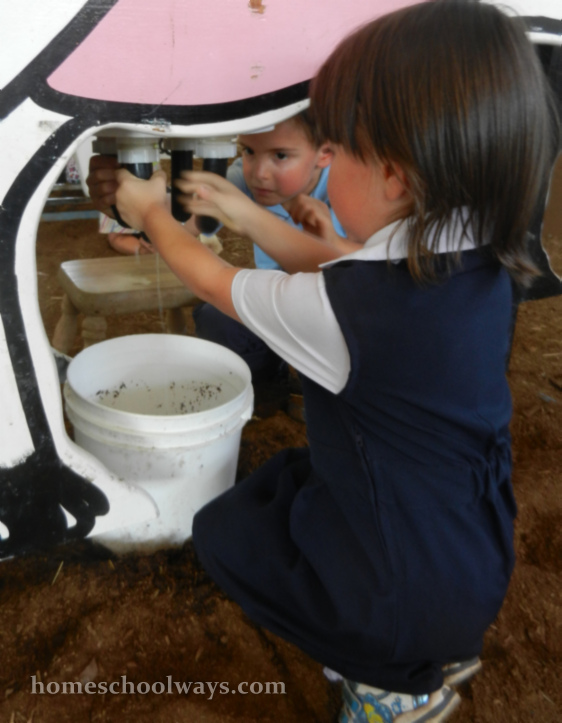
Milking

Milking

The fair staff were middle school and high school students from different area public schools, private schools and homeschools. I was amused when an elderly lady asked the girl at the sheep pen, “Did you kids have to get out of school today to do this?”

The answer came respectfully, “We homeschool, so this counts as school for us.” The facial expression of the lady who asked the question spoke volumes about the clash of concepts that had just happened. She was stunned. All she could say back was, “Oh, OK.”

I get that older generations in particular have a hard time accepting homeschooling, especially if they grew up attending quality little schools. I just wish the older generations could keep an open mind about, well, anything, including educational choices. And that they could be as gracious as this lady, no matter how weird homeschooling sounds to them. Wishful thinking… I linked this post up to

Join Me at The Homeschool Post!