5 Quick Points on Socialization and Homeschooling

Posted on

The other day I took my son to his science class, organized by our local aquarium specifically for homeschoolers. As I sat there looking at PowerPoint slides of bones and muscles, I also glanced occasionally at the students sitting on the carpet. They interacted well with each other and looked oh, so socialized.

And yet, public/private school parents still believe homeschooling produces social misfits. Mainstream parents also equate schooling with socialization. Generations of parents have been lead to believe that children belong together in age-segregated classrooms. Nothing could be further from the truth.

Here are 5 thoughts that hit me that afternoon during my son’s science class:

1. Introverts will be introverts. My Myers-Briggs profile is INTJ – Introversion, iNtuition, Thinking, Judgment. I attended public school and, before that, I was in day care. I have friends and I enjoy public speaking, but I will always be an introvert. Personality does not change. Shy children will be shy no matter where they went to school.

2. Public school is not the real world. When I was deciding on educational choices for my children, some people encouraged me to send them to public school because “public school is the real world.” Nonsense. Where else in your post-college world will you spend seven hours a day with 25 other people your age?

The best way to socialize a child is by exposing her to different age groups and different social situations – and homeschooling affords that as we take our children to different co-op classes, orchestra events, 4-H groups, mission trips, nursing homes etc. That’s the real world.
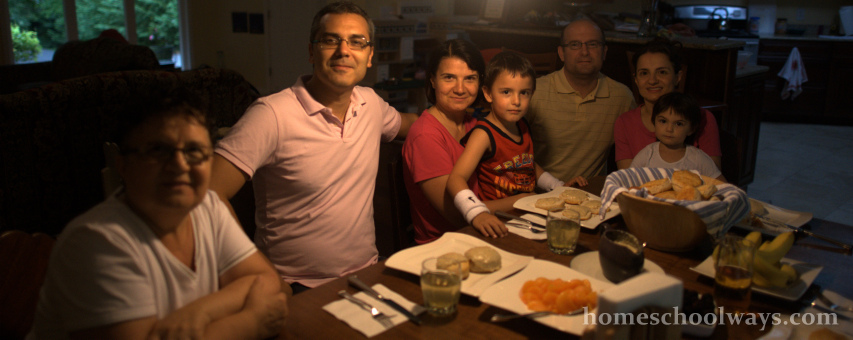
My extended family dining together

My extended family having breakfast together

3. Do not underestimate the mommy factor. Dr. James Dobson talks and writes frequently about the importance of the mother in the lives of her children. Research shows that children who grow up in the care of somebody else other than their mother show more aggressive behavior and disobedience than those raised at home by their own mom.

4. Socialization is a non-issue. If anybody asks you “What about socialization,” they simply show their ignorance about all the research on the matter. By the way, here are 7 ways to answer the socialization question. Sure, there are some homeschoolers who de-cry their parents’ way of socializing them, but we all know social misfits who attended public school. Homeschoolers will have some bad experiences just as public/private school students will have bad experiences.

5. Spending long periods of time with peers does not lead to higher intelligence. Madeline’s eleven peers wanted their appendix out, too. They saw Madeline, a popular kid, show off a scar as a badge of honor. They also saw the dollhouse and gifts Madeline’s papa sent while she was in the hospital. They did not think about Madeline’s pain. They wanted surgery because Madeline had surgery and she got all that. It’s called peer pressure and not thinking things through – the modus operandi of traditionally-schooled children.

While deciding to homeschool, I struggled with many questions, but socialization was not one of them because I had read the Smithsonian Institution’s recipe for genius and leadership from “The Childhood Pattern of Genius” by  H. McCurdy:

a. Children should spend a great deal of time with loving, educationally minded parents;

b. Children should be allowed a lot of free exploration; and

c. Children should have little to no association with peers outside of family and relatives.

Far from producing loners, homeschooling provides a platform for raising leaders and thinkers. Quod erat demonstrandum.


Best Blog Design Winner – Thanks for Voting!

Posted on

The-2013-Homeschool-Blog-Awards-WinnerThank you so much for your votes! Homeschool Ways won under The Best Blog Design category.

I feel honored and humbled to have shared the nomination screens in eight categories with very talented bloggers, many of whom have been at it for a lot longer than I have.

Congratulations to the winners in all other categories!

Every homeschool blogger who pours her heart out is a winner today because they raise awareness about homeschooling and its ministry to the world. By producing the good, responsible citizens of tomorrow, we all make the world a better place.

Thank you to Caroline Moore for designing the Scrappy theme for WordPress – the one I am using. This award belongs to you, Caroline.

To my amazing readers, thank you for reading this blog and voting for me. This is your award, too.

Last but not least, I would like to thank God for this award. In my weakness, He made me strong.


The Old Schoolhouse Magazine Review

Posted on

When it became clear that I would homeschool my children, toward the end of February 2012, I looked for the best homeschool magazine. I found three and could not pick one, so I subscribed to all of them: “Practical Homeschooling Magazine,” “Homeschool Enrichment Magazine” and “The Old Schoolhouse Magazine.”

After almost two years of trying them out, I decided that they all have great content, but:

1. I don’t want to take the time to read three homeschool magazines,

2. Paper magazines clutter my house, and

3. Free is better than paid.

And the winner is – drum roll please – “The Old Schoolhouse Magazine” or TOS for short. Here’s the vendor website where you can sign up for it.

 photo TOSGraphic_zpse554d8dc.jpg
You see, the other two, as great as they are, come in a paper format – like, one must walk to one’s mailbox to get them. Also, one pays for them. So 20th century.

“The Old Schoolhouse Magazine,” on the other hand, is free, digital, and contains 177 pages, chock-full of homeschooling tips (as opposed to 50 pages in the aforementioned paid, paper magazines). I read TOS on my laptop, or on my tablet, or on my smartphone. I get an email when the latest issue is available. I click on the link and voilà: magazine. Did I mention it is free?

Let’s look at “The Old Schoolhouse Magazine” November-December 2013 issue and you will see how many benefits one receives from being subscribed to a free digital homeschooling magazine. For the TOS app, click here.

For starters, the cover of every issue shows an old school building (the old schoolhouse… get it?) from somewhere in the United States. The first page tells the story behind the picture, which a homeschooling mom could easily use for a quick geography and history lesson with the kids.

Different sections of the magazine clearly spell out what each article tackles, which is helpful. “The Informed Homeschooler” covers current events which can affect our homeschooling rights and methods. “The Unit Study Homeschooler” will attract those homeschooling moms who have made unit studies work for them.

“The Classical Homeschooler” caters to those who feel inclined towards a classical education at home. “The Tech Homeschooler” reviews the latest gadgets or educational software. “The Littlest Homeschooler” dishes out advice on how to homeschool with preschoolers underfoot. You get the idea.

Another section of the magazine, peppered throughout for variety, is “Academic Spotlight.” In the November/December 2013 issue of “The Old Schoolhouse Magazine,” they focused on music and phonics/reading.

Personally, I find that I read most of the magazine, but not all of it. For instance, I am not much of a unit study homeschooler, so I will probably not read an article about unit studies. However, I will read about classical education, art, music, legal issues, current events, organizing, and college prep.

I also read most ads. If they made this magazine, those products must be good. Ads also contain hyperlinks which take you straight to their website for more information. How convenient!

Reading the TOS magazine takes me several evenings. After putting the kids to bed, I curl up with my laptop and read whatever fits best. Do I need a little spiritual perspective? I turn to “His Joyful Homeschooler” – a devotional section – or to the Editorial. Do I want a little inspiration from others? “Show and Tell” will do the trick.

I love how interactive reading “The Old Schoolhouse Magazine” feels. Some of the writers are bloggers and one can leave a comment on their blog with a mouse click. Now that’s the 21st century.

For more fun, exciting and, oh yes, useful reviews, please visit the Schoolhouse Review Crew website.

 photo Disclaimer2_zpsff718028.gif


3 Reasons to Switch Curriculum Mid-Semester

Posted on

I never wanted to switch curriculum mid-year, let alone mid-semester, partly because I am frugal and partly because I think that being flexible in homeschooling does not mean being indulgent. But then, I found myself teaching preschool math from a kindergarten textbook to a kindergartner who in reality operated on a first grade level.

One of the many reasons I homeschool my children is that it allows for a customized educational experience. By doing so, I go against the flow even in the USA. More Americans customize their cup of coffee than their children’s education, which is sad to me.

If you find yourself in any of the following situations, you will want to switch curriculum mid-semester, too.

1. Your child’s mind operates on a different level than the textbook. Every time I said “Time for math,” my son groaned. I added more manipulatives before our very minimal pen and paper practice. After all, he is a boy. The manipulatives helped a bit, which bought me more time to decide if I was dealing with an attitude or a real situation.

One day, he told me that he liked math better than reading. This confused me even further, because he reads on a third grade level and he loves books. A few days later, out of the blue, he wrote addition facts – and we have not even covered addition – on several pieces of paper and stapled the pages into a booklet. My son was asking to be challenged.

2. The textbook level is different than the content it promises. After teaching Singapore Math Earlybird Kindergarten for seven weeks, I realized it contained preschool material.

I received confirmation of that fact one day when my daughter’s preschool Rod and Staff workbook coincided with my son’s Singapore Math Kindergarten lesson – matching quantities by drawing lines.

3. The curriculum has the wrong approach either in general or for your child’s learning style. In our case, Singapore Math had the wrong approach in general. As I wondered how to advance my son without skipping math concepts he might not have already grasped, a homeschooling friend sent me an email extolling the benefits of Right Start Mathematics (RSM). Providential? I think so.

Here’s what I found out. Of course one can add more manipulatives and make Singapore Math more hands on. But, ultimately, it is still a traditional approach to math – numbers are points along a line, each being “one more” than the previous.

RSM, on the other hand, de-emphasizes counting and provides strategies (visualization of quantities) for learning math facts. For instance, RSM groups quantities in fives and tens. This enables your child to recognize quantities without counting. RSM students visualize seven as five and two, eight as five and three etc.

Based on Montessori principles and abacus work, RSM practices math concepts through games and very few worksheets. In my situation, the best part is that, as an entry level, RSM Level B (which corresponds to First Grade) covers all the basic math facts from the beginning, but faster than Level A.

My son loves building with LEGO bricks and finds the abacus fascinating. He has already found ways to build designs with it, beyond his math assignments.

If you need support, check out the RSM How To Videos. I found the RSM Yahoo Group members and archived files extremely helpful while researching whether I should switch.

Homeschooling happens at the intersection of our expectations and our children’s behavior and performance in class. By switching to RSM Level B, I placed my son in first grade and – bonus – I found a better way to do math. Have you ever had to switch curriculum mid-semester? Please leave me a comment below.


French Friday, Numbers 1-20

Posted on

Hope you had a good homeschooling week. My children have learned some new skills this week and I certainly have learned a few things myself. They say if you really want to learn something, teach it.

For today’s French lesson, I made flash cards with numbers 1-20.

Numbers 1 to 20 in French, French Friday

Click on the link below to open the PDF file or to save it to your computer.

French Numbers 1-20

Hope you find this useful! For more French Friday posts, please click here.

Please leave me a comment below. Happy homeschooling!


Thanksgiving and Homeschooling

Posted on

This time of the year, I reminisce about how, just before Thanksgiving, when my son was one, my heart told me I would homeschool. I did not understand it right then. Hindsight is 20/20. But I should have seen it coming, this desire to homeschool. I should have known it was going to grow and take over my life like few things have conquered me.

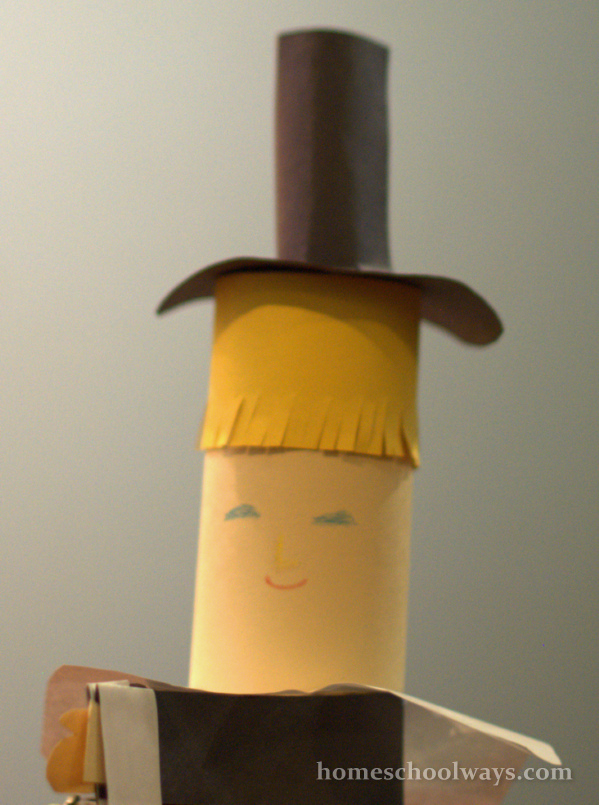
You see, five years ago, I scoured the Internet for “Thanksgiving crafts.” I made a list of supplies and bought them dutifully. My son watched me as I printed, measured, cut and pasted construction paper. Of course he could not help. He was one. I made this:

Pilgrim Boy Thanksgiving Craft

Pilgrim boy Thanksgiving craft I made in 2008

A pilgrim boy. I also printed out two Indian children – a boy and a girl – for him to color. Hopefully, they are in the box of early craft projects I decided to keep. My son grabbed the crayon and scribbled all over the coloring page like only a one-year-old can. I felt so proud.

That should have been my first clue that I wanted to homeschool. No preacher or friend pressured me into it. Alas, I don’t read my own heart-directed actions well. At the time, staying home with my child for a few years seemed like the most I could do before running back into the work force. I grew up thinking that exchanging my skills for money was the only dignified way to live my life. Motherhood fulfilled me, but I was programmed to want a career, too.

I discovered that the more time I spent with my son, the less I wanted to leave him. Then, I felt the desire for a second child. We welcomed our daughter and, by then, the little bud, my desire to teach my own, had grown into a plant I could not ignore. And yet, I did. I pushed it to the side, sleep-deprived and up to my knees in diapers and bibs.

The pilgrim boy graced our Thanksgiving table every year. I protected it from chubby hands by placing it on top of a book shelf the rest of the time. It collected dust. I felt it held a secret message, a prediction for the future, but I was not ready for it.

Two years ago, the plant – my desire to homeschool – had become a small tree. God asked me to stop pretending like it did not exist. I researched homeschooling thoroughly. The pilgrim boy craft, with its enigmatic smile, revealed its secret.

I will always treasure this Thanksgiving craft because it was the first inkling my heart gave me that my children have turned a PDA-wielding professional into a craft-seeking, cut-and-paste project preschool teacher. At home. The other grades will come in due time. Wait. Kindergarten already has. We are still at home. I would not have it any other way. This post has been linked to Blog and Tell with @hsbapost Show us your Orange


French Friday, To Be and To Have

Posted on

Homeschoolers, pay attention! This is by far the most important French lesson you will ever have. Without the present tense for être and avoir, the most used and most irregular verbs in French, you will not go anywhere. Period.

Without these two verbs, you cannot express anything like “I’m hungry” or “I am twelve.” Moreover, you cannot even come close to “I have eaten” or “I have gone.” You see, être and avoir play the role of auxilliary verbs to express le passé composé (the most common French past tense).

Sorry, no shortcuts to greatness. This one must be memorized. Take five minutes in your homeschool schedule and go through these daily.

Avoir et Etre - French Friday

ÊTRE

je suis [zhuh sew-ee]

tu es [tew eh]

il est / elle est [eel eh] / [ehl eh]

nous sommes [nooh sohm]

vous êtes [voohz-eht] – Notice how the s sounds like a z and it connects the two words. Most words ending in s in French will connect audibly as a z sound to the next word, if the latter begins with a vowel.

ils sont / elles sont [eel sohn] / [ehl sohn] In case you don’t know, n is a very nasal n sound.


AVOIR

j’ai [jeh]

tu as [tew ah]

il a / elle a [eel ah] / [ehl ah]

nous avons [nooz-avohn]

vous avez [vooz-aveh]

ils ont / elles ont [eelz-ohn] / [ehlz-ohn]

C’est tout. That’s it. Memorize these two verbs until you know them like the back of your hand. They will serve you well for the rest of your French lessons. The more you practice, the easier it will be to build on this foundation.

For other French Friday posts, click here. Happy homeschooling!


Homeschool Blog Awards – I’m a Nominee!

Posted on

Update: November 19, 2013. Voting is now closed. Thank you so much for taking the time to vote for me. We will wait for a few days to see the results of your hard work. 🙂

I am thrilled to let you know that this blog has been nominated for the following awards on the Homeschool Blog Award Post:

1. Favorite Homeschool Mom Blog

3. Best Blog Design

4. Best Photos Blog

5. Best Crafts, Plans and Projects Blog

6. Best Family or Group Blog – This does not really apply. I don’t know how I landed in that category. 🙂 Please don’t vote for me under Category 6.

7. Best Encourager

8. Best Current Events, Opinions or Politics Blog – This does not exactly represent my blog, so please don’t vote for my blog in this category.

18. Best NEW Homeschool Blog – please vote for me in this category

Of course, if you have the time and the inclination, you can give me a vote in all the categories I was nominated for (except 6 and 8 because they just don’t apply). But I would prefer to get recognition under Category 18, Best NEW Homeschool Blog, if I can choose. Thank you for the effort. Time is so precious for everybody.

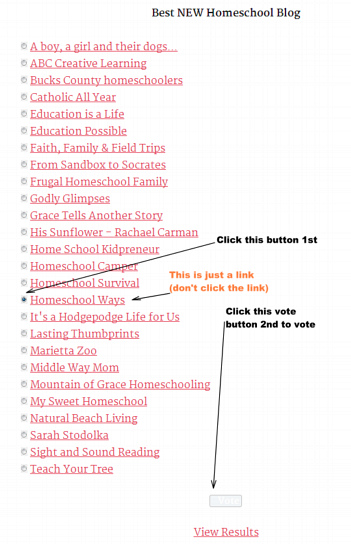
A note about the voting page. If you click on the blog name, it will take you to my site. That’s not a vote. You must click on the small dot to select the blog and then click the vote button at the bottom of the page  – see the diagram below. The screen will look differently on different devices, too. For instance, the dot may be in the middle of the screen and not to the left of the blog.

HSBA Blog Awards How To Vote

So you can vote daily, November 4-18, 2013. It’s all happening on www.hsbapost.com. Please read the rules first. Make sure you don’t vote more than once a day from the same device (desktop, laptop, iPad, smartphone etc.). It’s against the rules. I had some enthusiastic fans vote for me fifteen times in a row in one day before they read the rules. 🙂

But yes, if you can spare a minute a day for this blog, please vote daily through November 18 under Category 18, Best NEW Homeschool Blog.

HSBA_2013-Nominee-120x260

This may look like a competition, but it’s really meant to be fun and friendly. We are simply trying to help raise awareness about great homeschooling blogs you would otherwise not even know existed.

I have personally visited some of these blogs and voted for them in different categories where I was not nominated. I just don’t want to cancel out a fan’s vote on my behalf, you see. 🙂


Fall Traditions – Canning Applesauce

Posted on

The most important reason I homeschool is that I want to spend time with my children and make lots of memories. Their adulthood will be so much longer than their childhood. I want them to remember I offered them not just quality time, but also quantity time.

This is where fall traditions come in. We could can applesauce any other month of the year. When I called a farmer once to check if they had apples, she almost burst out laughing and informed me the only month they do NOT have apples is February. September and October equal canning to me probably because my own mother canned during the fall.

Applesauce cooking in pot

Applesauce cooking in pot

We got so busy in September, we bumped canning to October. On the 30th, I figured it was that day or never. So all four of us got into the car and headed for the apple orchard.

We bought two bushels of apples because I wanted to produce 24 quarts of applesauce. My recipe is simple, straight out of the Ball Blue Book of Preserving: 3 lbs of apples per quart of applesauce. I do not use sugar at all. Just 2-3 cups of water per pot so the apples do not stick while cooking.

My son helped with the peeler-corer-slicer. Of course, it counted as Home Ec. In fact, that whole day went down in the books as a homeschool day with a field trip and a home ec project (besides Bible and reading books with daddy in English and with mommy in Romanian and French). My daughter helped with washing the apples. She said at one point, “This is so much fun…”

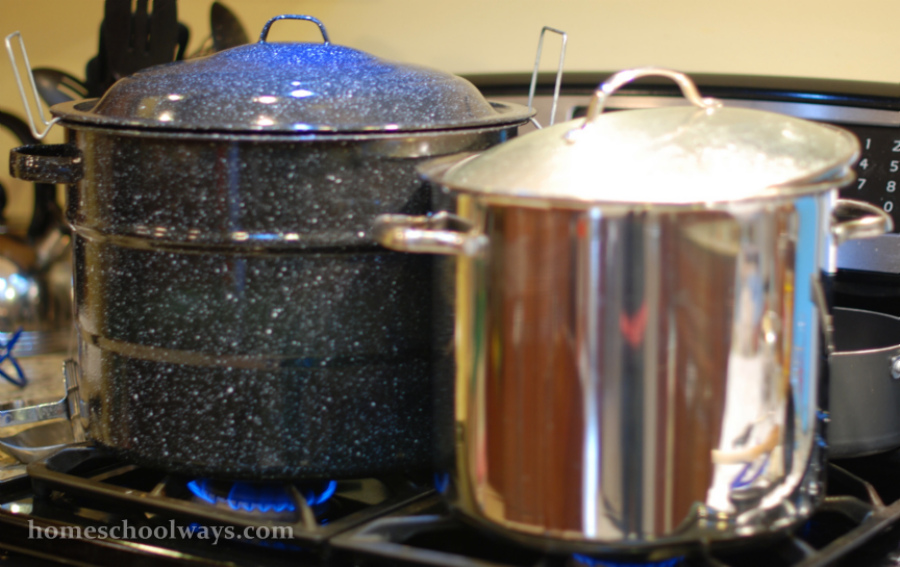
One pot heats up the water for the sealing process. The other cooks the apples down.

Water bath canner next to pot cooking applesauce

Water bath canner next to pot cooking applesauce

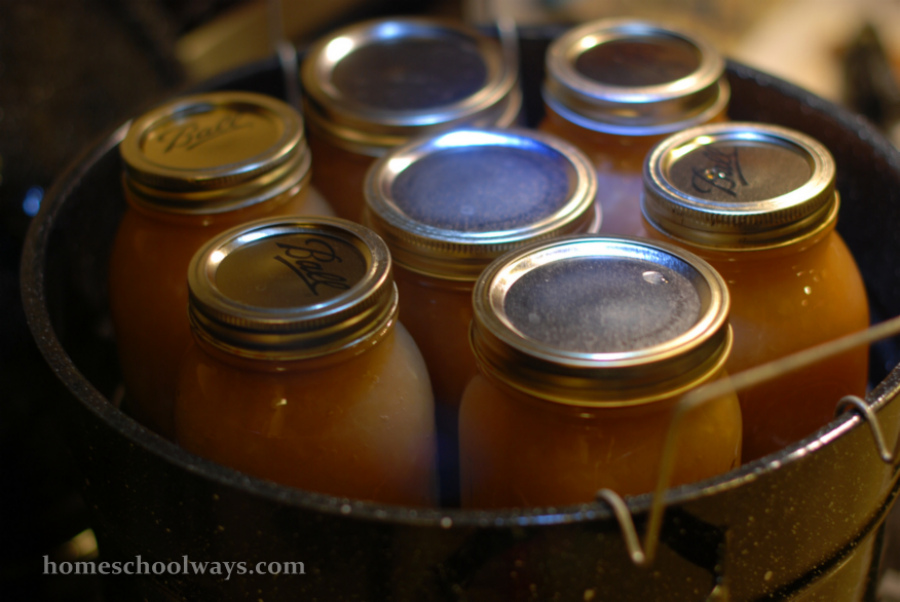
I process seven jars at one time, for 20 minutes.

Jars with applesauce before being lowered in a water bath canner

Water bath canner holds 7

And the result of our labor of love…

Applesauce jar on a shelf in our pantry

Applesauce jars on a shelf in our pantry

Homeschooling allows us to spend lots of time together, to make memories and establish traditions of different sorts. Canning applesauce is our fall tradition – more so than playing in a pile of leaves or visiting a pumpkin patch.


The Titanic Museum in Pigeon Forge

Posted on

In our homeschool, we try to incorporate one field trip a month. Ten days ago, we visited the Titanic Museum in Pigeon Forge. I wrote a column for The Mountain Press about it, which you can read here

I realize that light-hearted children and the Titanic story don’t mix well. I watched the Titanic being built and thought I would never visit such a sad place. I would weep throughout. I drove past it on a regular basis on my way home and never gave it a second thought.

Children of Titanic Gallery

Children of Titanic Gallery

As God took me in the direction of homeschooling, I became more aware of possible educational opportunities around us. Before we head over to other states or countries, we want to visit local museums. The Titanic, with its amazing online resources for homeschoolers, made the list. Two things were still missing though:

(1) My children did not even know what death meant and

(2) I needed a new perspective on how to visit a place which recalls human tragedy.

Well, this year, my children became aware of death. I have already answered many questions about death and human tragedies. What’s a few more? Besides, if I don’t talk to my children about what happens after we die, somebody will. And it might be the wrong person.

As to the needed new perspective, one day it just came over me. I realized that remembering the victims is honoring them. So we went. We saw, touched, learned and experienced. We loved the crew’s friendliness and, of course, their uniforms.

We pushed buttons, shoved coals into the furnace, solved 3D puzzles, touched 28F water, and tried to avoid the iceberg in 37 seconds. Their simulator is great! We learned what RMS stands for, how many dogs were aboard, and so much more, as we listened to our headsets.

In the “Titanic, The Movie” room, my daughter and I picked our favorite dresses from Kate Winslet’s wardrobe. The hats took our breath away. Leonardo diCaprio’s drowning scene costume looked small and oh, so dry and clean.

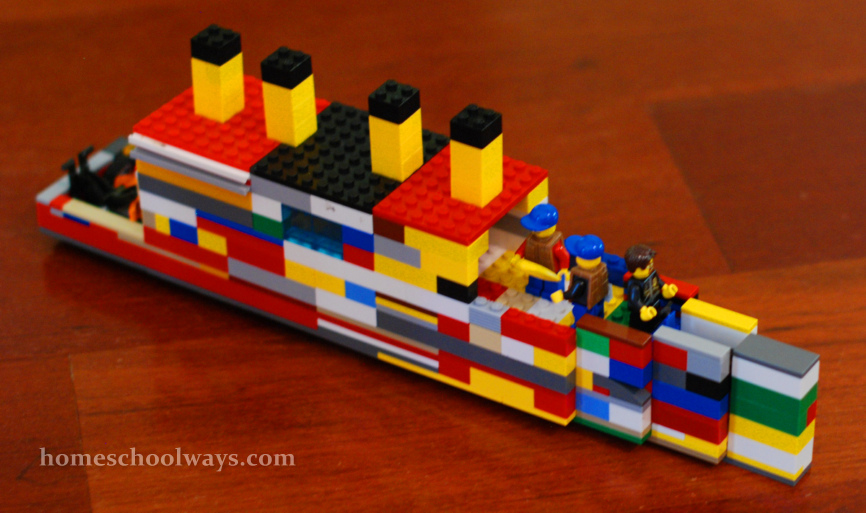
At home, my son decided to build a LEGO Titanic. Here’s what he came up with.

My son built this LEGO Titanic without instructions

My son built this LEGO Titanic without instructions

The kids ran out of patience toward the end of the tour, so we did not get a chance to look our aliases up on the wall of remembrance. These were cards we got in the beginning of the tour, with the names and stories of real passengers. A crew member read to us quickly about their fate, from a book they sell in the gift shop. Whew! We all made it out alright.

I knew that about my character from the very beginning, because they gave me none other than Molly the Unsinkable. I’ve decided that’s my new nickname. By the way, this should be the name of any homeschooling mom out there – we are the Unsinkables of the world. Take heart and enjoy the ride!