Thanksgiving and Homeschooling

Posted on

This time of the year, I reminisce about how, just before Thanksgiving, when my son was one, my heart told me I would homeschool. I did not understand it right then. Hindsight is 20/20. But I should have seen it coming, this desire to homeschool. I should have known it was going to grow and take over my life like few things have conquered me.

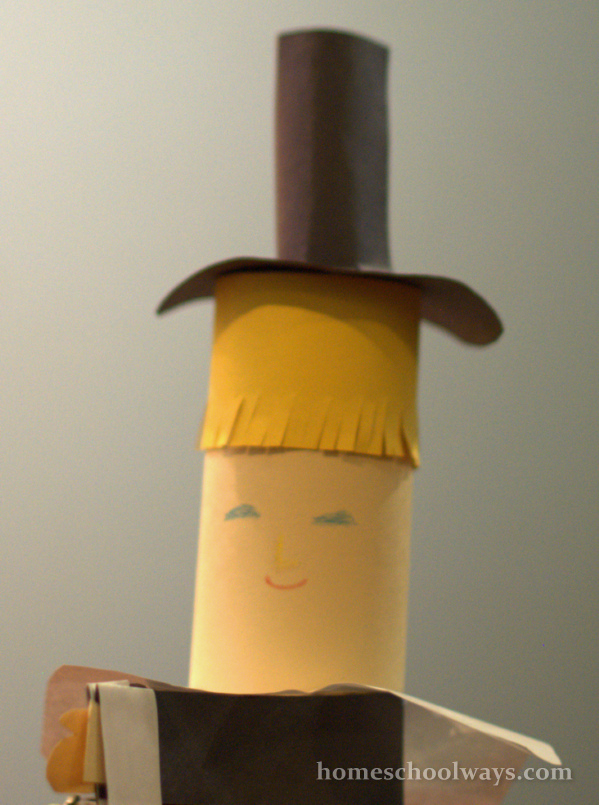
You see, five years ago, I scoured the Internet for “Thanksgiving crafts.” I made a list of supplies and bought them dutifully. My son watched me as I printed, measured, cut and pasted construction paper. Of course he could not help. He was one. I made this:

Pilgrim Boy Thanksgiving Craft

Pilgrim boy Thanksgiving craft I made in 2008

A pilgrim boy. I also printed out two Indian children – a boy and a girl – for him to color. Hopefully, they are in the box of early craft projects I decided to keep. My son grabbed the crayon and scribbled all over the coloring page like only a one-year-old can. I felt so proud.

That should have been my first clue that I wanted to homeschool. No preacher or friend pressured me into it. Alas, I don’t read my own heart-directed actions well. At the time, staying home with my child for a few years seemed like the most I could do before running back into the work force. I grew up thinking that exchanging my skills for money was the only dignified way to live my life. Motherhood fulfilled me, but I was programmed to want a career, too.

I discovered that the more time I spent with my son, the less I wanted to leave him. Then, I felt the desire for a second child. We welcomed our daughter and, by then, the little bud, my desire to teach my own, had grown into a plant I could not ignore. And yet, I did. I pushed it to the side, sleep-deprived and up to my knees in diapers and bibs.

The pilgrim boy graced our Thanksgiving table every year. I protected it from chubby hands by placing it on top of a book shelf the rest of the time. It collected dust. I felt it held a secret message, a prediction for the future, but I was not ready for it.

Two years ago, the plant – my desire to homeschool – had become a small tree. God asked me to stop pretending like it did not exist. I researched homeschooling thoroughly. The pilgrim boy craft, with its enigmatic smile, revealed its secret.

I will always treasure this Thanksgiving craft because it was the first inkling my heart gave me that my children have turned a PDA-wielding professional into a craft-seeking, cut-and-paste project preschool teacher. At home. The other grades will come in due time. Wait. Kindergarten already has. We are still at home. I would not have it any other way. This post has been linked to Blog and Tell with @hsbapost Show us your Orange


French Friday, To Be and To Have

Posted on

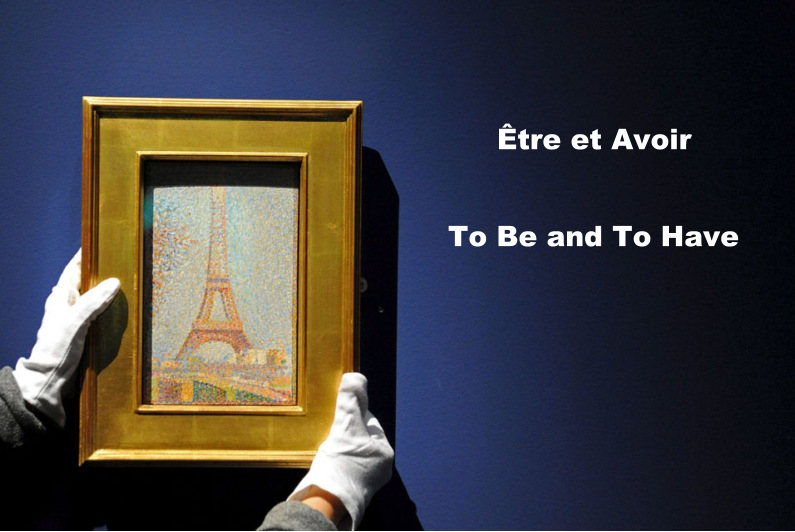
Homeschoolers, pay attention! This is by far the most important French lesson you will ever have. Without the present tense for être and avoir, the most used and most irregular verbs in French, you will not go anywhere. Period.

Without these two verbs, you cannot express anything like “I’m hungry” or “I am twelve.” Moreover, you cannot even come close to “I have eaten” or “I have gone.” You see, être and avoir play the role of auxilliary verbs to express le passé composé (the most common French past tense).

Sorry, no shortcuts to greatness. This one must be memorized. Take five minutes in your homeschool schedule and go through these daily.

Avoir et Etre - French Friday

ÊTRE

je suis [zhuh sew-ee]

tu es [tew eh]

il est / elle est [eel eh] / [ehl eh]

nous sommes [nooh sohm]

vous êtes [voohz-eht] – Notice how the s sounds like a z and it connects the two words. Most words ending in s in French will connect audibly as a z sound to the next word, if the latter begins with a vowel.

ils sont / elles sont [eel sohn] / [ehl sohn] In case you don’t know, n is a very nasal n sound.


AVOIR

j’ai [jeh]

tu as [tew ah]

il a / elle a [eel ah] / [ehl ah]

nous avons [nooz-avohn]

vous avez [vooz-aveh]

ils ont / elles ont [eelz-ohn] / [ehlz-ohn]

C’est tout. That’s it. Memorize these two verbs until you know them like the back of your hand. They will serve you well for the rest of your French lessons. The more you practice, the easier it will be to build on this foundation.

For other French Friday posts, click here. Happy homeschooling!


Homeschool Blog Awards – I’m a Nominee!

Posted on

Update: November 19, 2013. Voting is now closed. Thank you so much for taking the time to vote for me. We will wait for a few days to see the results of your hard work. 🙂

I am thrilled to let you know that this blog has been nominated for the following awards on the Homeschool Blog Award Post:

1. Favorite Homeschool Mom Blog

3. Best Blog Design

4. Best Photos Blog

5. Best Crafts, Plans and Projects Blog

6. Best Family or Group Blog – This does not really apply. I don’t know how I landed in that category. 🙂 Please don’t vote for me under Category 6.

7. Best Encourager

8. Best Current Events, Opinions or Politics Blog – This does not exactly represent my blog, so please don’t vote for my blog in this category.

18. Best NEW Homeschool Blog – please vote for me in this category

Of course, if you have the time and the inclination, you can give me a vote in all the categories I was nominated for (except 6 and 8 because they just don’t apply). But I would prefer to get recognition under Category 18, Best NEW Homeschool Blog, if I can choose. Thank you for the effort. Time is so precious for everybody.

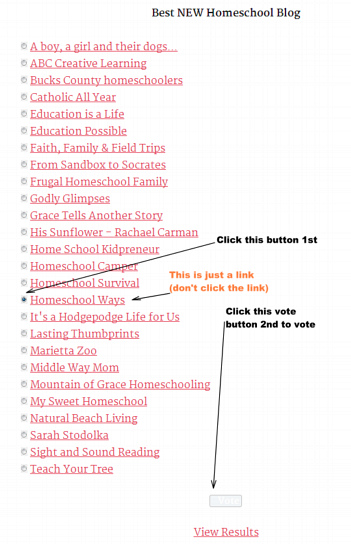
A note about the voting page. If you click on the blog name, it will take you to my site. That’s not a vote. You must click on the small dot to select the blog and then click the vote button at the bottom of the page  – see the diagram below. The screen will look differently on different devices, too. For instance, the dot may be in the middle of the screen and not to the left of the blog.

HSBA Blog Awards How To Vote

So you can vote daily, November 4-18, 2013. It’s all happening on www.hsbapost.com. Please read the rules first. Make sure you don’t vote more than once a day from the same device (desktop, laptop, iPad, smartphone etc.). It’s against the rules. I had some enthusiastic fans vote for me fifteen times in a row in one day before they read the rules. 🙂

But yes, if you can spare a minute a day for this blog, please vote daily through November 18 under Category 18, Best NEW Homeschool Blog.

HSBA_2013-Nominee-120x260

This may look like a competition, but it’s really meant to be fun and friendly. We are simply trying to help raise awareness about great homeschooling blogs you would otherwise not even know existed.

I have personally visited some of these blogs and voted for them in different categories where I was not nominated. I just don’t want to cancel out a fan’s vote on my behalf, you see. 🙂


Fall Traditions – Canning Applesauce

Posted on

The most important reason I homeschool is that I want to spend time with my children and make lots of memories. Their adulthood will be so much longer than their childhood. I want them to remember I offered them not just quality time, but also quantity time.

This is where fall traditions come in. We could can applesauce any other month of the year. When I called a farmer once to check if they had apples, she almost burst out laughing and informed me the only month they do NOT have apples is February. September and October equal canning to me probably because my own mother canned during the fall.

Applesauce cooking in pot

Applesauce cooking in pot

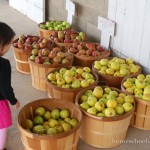
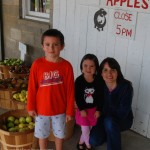
We got so busy in September, we bumped canning to October. On the 30th, I figured it was that day or never. So all four of us got into the car and headed for the apple orchard.

We bought two bushels of apples because I wanted to produce 24 quarts of applesauce. My recipe is simple, straight out of the Ball Blue Book of Preserving: 3 lbs of apples per quart of applesauce. I do not use sugar at all. Just 2-3 cups of water per pot so the apples do not stick while cooking.

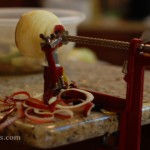
My son helped with the peeler-corer-slicer. Of course, it counted as Home Ec. In fact, that whole day went down in the books as a homeschool day with a field trip and a home ec project (besides Bible and reading books with daddy in English and with mommy in Romanian and French). My daughter helped with washing the apples. She said at one point, “This is so much fun…”

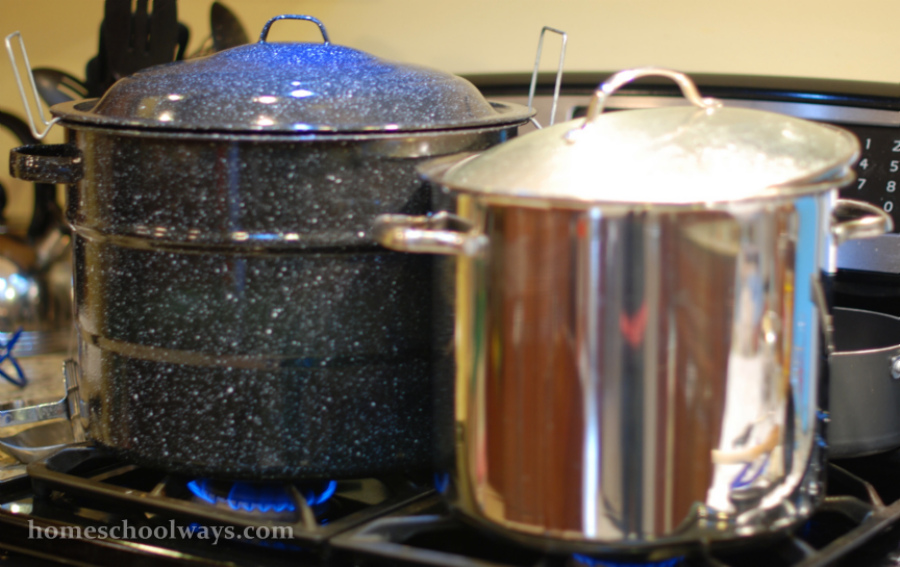
One pot heats up the water for the sealing process. The other cooks the apples down.

Water bath canner next to pot cooking applesauce

Water bath canner next to pot cooking applesauce

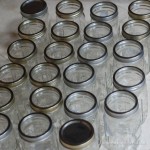
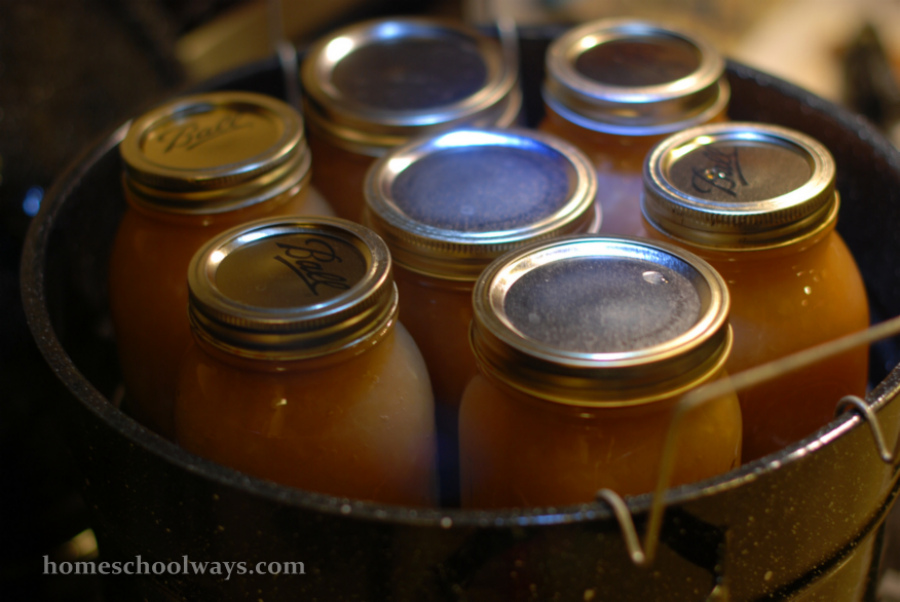
I process seven jars at one time, for 20 minutes.

Jars with applesauce before being lowered in a water bath canner

Water bath canner holds 7

And the result of our labor of love…

Applesauce jar on a shelf in our pantry

Applesauce jars on a shelf in our pantry

Homeschooling allows us to spend lots of time together, to make memories and establish traditions of different sorts. Canning applesauce is our fall tradition – more so than playing in a pile of leaves or visiting a pumpkin patch.


The Titanic Museum in Pigeon Forge

Posted on

In our homeschool, we try to incorporate one field trip a month. Ten days ago, we visited the Titanic Museum in Pigeon Forge. I wrote a column for The Mountain Press about it, which you can read here

I realize that light-hearted children and the Titanic story don’t mix well. I watched the Titanic being built and thought I would never visit such a sad place. I would weep throughout. I drove past it on a regular basis on my way home and never gave it a second thought.

Children of Titanic Gallery

Children of Titanic Gallery

As God took me in the direction of homeschooling, I became more aware of possible educational opportunities around us. Before we head over to other states or countries, we want to visit local museums. The Titanic, with its amazing online resources for homeschoolers, made the list. Two things were still missing though:

(1) My children did not even know what death meant and

(2) I needed a new perspective on how to visit a place which recalls human tragedy.

Well, this year, my children became aware of death. I have already answered many questions about death and human tragedies. What’s a few more? Besides, if I don’t talk to my children about what happens after we die, somebody will. And it might be the wrong person.

As to the needed new perspective, one day it just came over me. I realized that remembering the victims is honoring them. So we went. We saw, touched, learned and experienced. We loved the crew’s friendliness and, of course, their uniforms.

We pushed buttons, shoved coals into the furnace, solved 3D puzzles, touched 28F water, and tried to avoid the iceberg in 37 seconds. Their simulator is great! We learned what RMS stands for, how many dogs were aboard, and so much more, as we listened to our headsets.

In the “Titanic, The Movie” room, my daughter and I picked our favorite dresses from Kate Winslet’s wardrobe. The hats took our breath away. Leonardo diCaprio’s drowning scene costume looked small and oh, so dry and clean.

At home, my son decided to build a LEGO Titanic. Here’s what he came up with.

My son built this LEGO Titanic without instructions

My son built this LEGO Titanic without instructions

The kids ran out of patience toward the end of the tour, so we did not get a chance to look our aliases up on the wall of remembrance. These were cards we got in the beginning of the tour, with the names and stories of real passengers. A crew member read to us quickly about their fate, from a book they sell in the gift shop. Whew! We all made it out alright.

I knew that about my character from the very beginning, because they gave me none other than Molly the Unsinkable. I’ve decided that’s my new nickname. By the way, this should be the name of any homeschooling mom out there – we are the Unsinkables of the world. Take heart and enjoy the ride!


French Friday, Top 10 French Words

Posted on

Hello again, on a French Friday morning. Or, should I say, Bon matin (Good morning)! Do you have ten minutes in your homeschooling schedule to squeeze in a bit of French? Oui? (Yes?) Très bien, alors! (Very well, then!)

Have you always wanted to learn French but never knew where to start? Wonder no more. Here are the Top 10 most frequently used French words, according to Gougenheim 2.00 – Fréquences orales et de production. Please find the pronunciation guide within [ ] and the English translation after the equal sign.

Top 10 French Words

1. le [luh], la [lah], l’ [l], les [lay] = the (definite article)

Can you believe French has four words where English only has one? That’s because French nouns are masculine (le), feminine (la), begin with a vowel (which makes le/la drop their own vowels and become l’), or need a plural article when they are in the plural form (les).

2. être [eh-tr] = to be (verb)

3. avoir [ah-vwahr] = to have (verb)

4. de [duh] = of, from (preposition)

5. un [uhn], une [yewn], des [day] = a, an, some (indefinite article) Masculine nouns in French require “un”, feminine nouns require “une” and plurals call for “des.”

6. je [zhuh] = I (subject pronoun)

7. il/ils [eel] = he, it / they (subject pronouns)

8. ce [suh] = this (indefinite demonstrative pronoun)

9. pas [pah] = not (negative adverb)

10. à [ah] = to, in (preposition)

Please let me know what kind of resources would best work for your French-learning needs in your homeschool. For more French Friday lessons, click here. À bientôt! (See you soon!)


Before Five in a Row

Posted on

Last year, my son turned five and my daughter turned three. I did not buy a preschool curriculum-in-a-box. We read a lot of books instead and did living math. Homeschooling gives me that flexibility. Besides, I really like the Charlotte Mason approach which replaces textbooks with living books.

I did not know how to come up with different activities based on what we were reading, so I bought Before Five in a Row (BFIAR) – the Five in a Row (FIAR) volume designed for children ages 2-4. In a different format than the regular FIAR volumes (which are meant for ages 4-8), BFIAR introduced us to a fascinating list of children’s classics and provided suggestions for activities based on the stories and concepts in the books.

This taught me how to put together a unit study – an approach which I could then take to other books we read, not included in BFIAR. That skill right there is worth the money for a new copy. Check out the amazon price below – better than on the FIAR website.

We read most of the BFIAR books from the library. We owned two titles and eventually found a third one at a homeschooling curriculum fair. Honestly, I did not feel the need to own them all. We already have many, many books.

My children loved all the titles and kept asking me to read them again and again and again. I think I read Blueberries for Sal a hundred times. OK, so maybe I read it only 14 times and it felt like a hundred times. When I got really bored, I focused on their enjoyment of the book. It helped.

After reading Blueberries for Sal, my children wanted to drop five frozen blueberries in a metal bowl every day just so they could go, “Kerplink, kerplank, kerplunk.” It’s the kind of memory that will stay with a mom (and her children) forever.

Before Five in a Row will always be the first curriculum (although the FIAR publishers tell you FIAR is not a curriculum) we ever tried and loved. If you love reading to your children and don’t know how to create a unit study based on what you are reading, I suggest you learn from BFIAR.

Some of the activities will go over the head of a two-year-old, so you can either work them with your older preschoolers or skip them altogether. Homeschooling allows for a tailored approach. Every time.


Free Ebook – 21 Days to Jumpstart Your Homeschool

Posted on

Is your homeschool running low on fuel? Do you need to connect to an external Power Source – the One Who called you to homeschool in the first place? Then get your copy of my FREE ebook, 21 Days to Jumpstart Your Homeschool.

Part devotional, part workbook, this step-by-step guide helps you achieve more and stress less. I wrote it to encourage fellow travelers on the homeshooling journey.

Convenient, compelling and clear-cut, 21 Days to Jumpstart Your Homeschool will quickly improve the health of your homeschool through fun, exciting and personalized exercises. Click on the book cover below to download or sign-up from the sidebar menu.

21 Days to Jumpstart Your HomeschoolThe effort it takes to homeschool your children can leave you running on your own juices. Bring new energy into your homeschool by reading and working through this free ebook. Download it now and uncover simple solutions for guaranteed results. (Already subscribed? Look for an email in your inbox later today, with the link to download the book.)


French Friday, Alouette

Posted on

Last Friday, I started a series of French lessons which I plan to turn into a permanent tab on my blog. Homeschooling would not be complete without at least one foreign language, right?

Today, let’s look at one of the most famous French songs ever: Alouette. Children use this song to learn the names of body parts in French.


Alouette

Refrain: Alouette, gentille alouette,

Alouette, je te plumerai.

1. Je te plumerai la tête. x2

Et la tête! Et la tête!

Alouette! Alouette!

A-a-a-ah

Refrain

2. Je te plumerai le bec. x2

Et le bec!  x2

Et la tête!  x2

Alouette!  x2

A-a-a-ah

Refrain

Alouette - Lark - body parts in French

Body parts in French, on a lark (alouette)

3. Je te plumerai les yeux. x2

Et les yeux!  x2

Et le bec!  x2

Et la tête!  x2

Alouette!  x2

A-a-a-ah

Refrain

Repeat the above with: le cou, les ailes, les pattes, la queue,  le dos.

Literally, the song says, “Lark, lovely lark, I will pluck the feathers off your head, beak, eyes, neck, wings, feet, tail, back.”

To sing Alouette in English, use

Little skylark, lovely little skylark,

Little skylark, I’ll pluck your feathers off.

I’ll pluck the feathers off your head, x2

Off your head, x2

Little lark, x2

O-o-o-oh etc

Apparently, a lark woke the song writer up one morning and he was not an early bird (no pun intended) or a card-carrying member of PETA. He calls the lark “lovely” or “nice” (gentille) though, which intrigues me. The song may have originated in France, but it is also attributed to Québec, the French-speaking Canadian province.

To hear the pronunciation, here’s a youtube video with a kid-friendly arrangement. Hope this little French song enriches your homeschool day!


My Top 10 Strategies for Raising Polyglots

Posted on

Because of my European background,  I want to raise polyglots even though we live in the United States. It helps that I homeschool – it gives me time to speak and read to them in different languages. If they went to school for seven hours a day in the majority language (English), it would put every other target language (Romanian, French, Spanish) at a huge disadvantage.

This post is linked to

I focus on Romanian and French for now. I decided I would add Spanish to the mix only after we get a grip on these two. Their daddy is American, so it’s all English with him.

So here are my Top 10 strategies for raising polyglots:

1. I spoke to them in the target language from birth. When others around us must understand my conversation with my children, I switch to English. Even though I live and homeschool in the US, I use Romanian as the language of instruction as much as I can. I repeat new concepts and vocabulary in both Romanian and English to make sure they get it.

2. I read to them in the target language at least 20 minutes a day. At first, I translated from English into Romanian. As the books got more complex, I switched to reading in English from English books, in French from French books and in Romanian from Romanian books.

3. We sing and listen to music in Romanian and French. While they play or eat, we turn it on in the background. They really like it. I point out some words if they are interested.

4. We Skype regularly in Romanian with my family or friends. Any French-speaking kids out there that we can Skype with?

5. I brush up on my own language skills by reading books, newspapers and blogs in French (or other languages). I listen to the news in French.

6. We listen to Radio France International, especially Le Journal en Français Facile for the children’s sake.

7. My children stumbled upon Fireman Sam in French and Robocar Poli in Korean on youtube. They even found Postman Pat in Dutch. When a character is hanging on a cliff yelling HELP in another language, they get it. Caution: TV viewing harms small children’s brain. My children are three and almost six. We only allow them 30 minutes daily, if at all.

8. We look to make friends with people who speak French or Romanian in our area. It’s tough though. But I keep hoping.

9. When the children get older, we will take them on trips to Québec and France.

10. Once my children can write, we plan to find them pen pals. Hopefully, my community of multicultural bloggers will hook me up in a few years (hint, hint).

I take teaching languages seriously, but I’m relaxed about it. Children don’t need pressure. Through it all, I am thankful that homeschooling allows me the time to accomplish my goal of raising polyglots in the good ol’ USA.