French Friday, To Be and To Have

Posted on

Homeschoolers, pay attention! This is by far the most important French lesson you will ever have. Without the present tense for être and avoir, the most used and most irregular verbs in French, you will not go anywhere. Period.

Without these two verbs, you cannot express anything like “I’m hungry” or “I am twelve.” Moreover, you cannot even come close to “I have eaten” or “I have gone.” You see, être and avoir play the role of auxilliary verbs to express le passé composé (the most common French past tense).

Sorry, no shortcuts to greatness. This one must be memorized. Take five minutes in your homeschool schedule and go through these daily.

Avoir et Etre - French Friday

ÊTRE

je suis [zhuh sew-ee]

tu es [tew eh]

il est / elle est [eel eh] / [ehl eh]

nous sommes [nooh sohm]

vous êtes [voohz-eht] – Notice how the s sounds like a z and it connects the two words. Most words ending in s in French will connect audibly as a z sound to the next word, if the latter begins with a vowel.

ils sont / elles sont [eel sohn] / [ehl sohn] In case you don’t know, n is a very nasal n sound.


AVOIR

j’ai [jeh]

tu as [tew ah]

il a / elle a [eel ah] / [ehl ah]

nous avons [nooz-avohn]

vous avez [vooz-aveh]

ils ont / elles ont [eelz-ohn] / [ehlz-ohn]

C’est tout. That’s it. Memorize these two verbs until you know them like the back of your hand. They will serve you well for the rest of your French lessons. The more you practice, the easier it will be to build on this foundation.

For other French Friday posts, click here. Happy homeschooling!
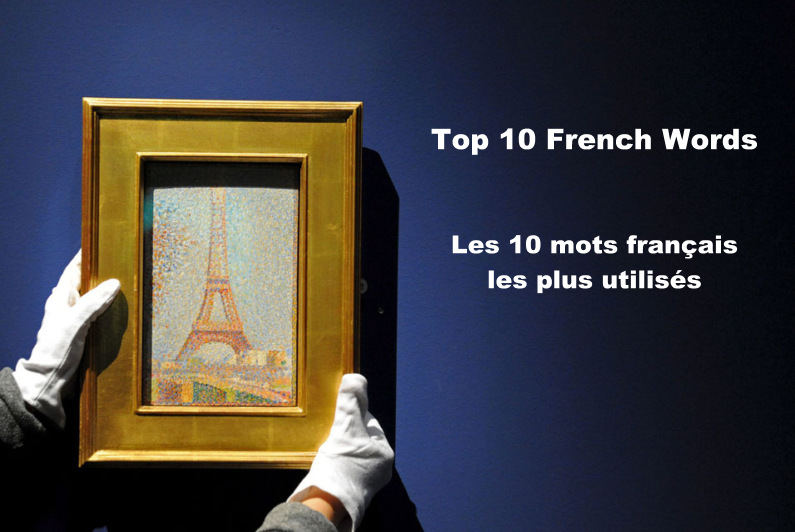

French Friday, Top 10 French Words

Posted on

Hello again, on a French Friday morning. Or, should I say, Bon matin (Good morning)! Do you have ten minutes in your homeschooling schedule to squeeze in a bit of French? Oui? (Yes?) Très bien, alors! (Very well, then!)

Have you always wanted to learn French but never knew where to start? Wonder no more. Here are the Top 10 most frequently used French words, according to Gougenheim 2.00 – Fréquences orales et de production. Please find the pronunciation guide within [ ] and the English translation after the equal sign.

Top 10 French Words

1. le [luh], la [lah], l’ [l], les [lay] = the (definite article)

Can you believe French has four words where English only has one? That’s because French nouns are masculine (le), feminine (la), begin with a vowel (which makes le/la drop their own vowels and become l’), or need a plural article when they are in the plural form (les).

2. être [eh-tr] = to be (verb)

3. avoir [ah-vwahr] = to have (verb)

4. de [duh] = of, from (preposition)

5. un [uhn], une [yewn], des [day] = a, an, some (indefinite article) Masculine nouns in French require “un”, feminine nouns require “une” and plurals call for “des.”

6. je [zhuh] = I (subject pronoun)

7. il/ils [eel] = he, it / they (subject pronouns)

8. ce [suh] = this (indefinite demonstrative pronoun)

9. pas [pah] = not (negative adverb)

10. à [ah] = to, in (preposition)

Please let me know what kind of resources would best work for your French-learning needs in your homeschool. For more French Friday lessons, click here. À bientôt! (See you soon!)


French Friday, Alouette

Posted on

Last Friday, I started a series of French lessons which I plan to turn into a permanent tab on my blog. Homeschooling would not be complete without at least one foreign language, right?

Today, let’s look at one of the most famous French songs ever: Alouette. Children use this song to learn the names of body parts in French.


Alouette

Refrain: Alouette, gentille alouette,

Alouette, je te plumerai.

1. Je te plumerai la tête. x2

Et la tête! Et la tête!

Alouette! Alouette!

A-a-a-ah

Refrain

2. Je te plumerai le bec. x2

Et le bec!  x2

Et la tête!  x2

Alouette!  x2

A-a-a-ah

Refrain

Alouette - Lark - body parts in French

Body parts in French, on a lark (alouette)

3. Je te plumerai les yeux. x2

Et les yeux!  x2

Et le bec!  x2

Et la tête!  x2

Alouette!  x2

A-a-a-ah

Refrain

Repeat the above with: le cou, les ailes, les pattes, la queue,  le dos.

Literally, the song says, “Lark, lovely lark, I will pluck the feathers off your head, beak, eyes, neck, wings, feet, tail, back.”

To sing Alouette in English, use

Little skylark, lovely little skylark,

Little skylark, I’ll pluck your feathers off.

I’ll pluck the feathers off your head, x2

Off your head, x2

Little lark, x2

O-o-o-oh etc

Apparently, a lark woke the song writer up one morning and he was not an early bird (no pun intended) or a card-carrying member of PETA. He calls the lark “lovely” or “nice” (gentille) though, which intrigues me. The song may have originated in France, but it is also attributed to Québec, the French-speaking Canadian province.

To hear the pronunciation, here’s a youtube video with a kid-friendly arrangement. Hope this little French song enriches your homeschool day!